

What Is Investment Casting? A Practical Guide to the Lost-Wax Process
Investment casting is a metal-forming process in which a wax replica of the part is coated in ceramic, the wax is melted out, and molten metal is poured into the hollow shell that remains. Because the shell captures every detail of the wax pattern, the finished part comes out close to its final shape, with surfaces and tolerances that sand casting can’t match and machining can only reach at a much higher cost per piece.
If you are a design engineer or a sourcing manager and you keep hearing “investment cast” or “lost wax” on supplier quotes, this guide covers what the process actually involves, what it can and can’t do, and how to tell whether it’s the right fit for your part.
Investment casting vs. lost-wax casting: are they the same thing?
Yes. “Lost wax casting” describes what happens to the pattern. “Investment casting” describes what happens to the mold: the pattern is “invested,” meaning surrounded, with a refractory slurry. Foundries and purchasing departments use the two terms interchangeably. You’ll also see “precision investment casting,” which usually just signals that the foundry holds tighter classes of tolerance than the industry baseline.
The process is old. Wax-pattern castings found in southern Israel have been carbon-dated to roughly 3700 BC. Its modern industrial life started in dentistry, when Dr. William H. Taggart of Chicago published a repeatable technique for casting gold inlays in 1907, and World War II then pushed it into aircraft engines, where net-shape turbine parts were needed faster than machine shops could cut them. The same basic sequence still runs in foundries today.
How investment casting works, step by step
Most guides list six or seven steps. On a real shop floor it’s closer to fifteen, and the extra steps are where quality is decided. Here is the sequence as it runs at Precimetal Cast in Gujarat, India, a lost-wax foundry operating since 2001. (The full 15-step vrsion, with photos, is on our investment casting process page.)
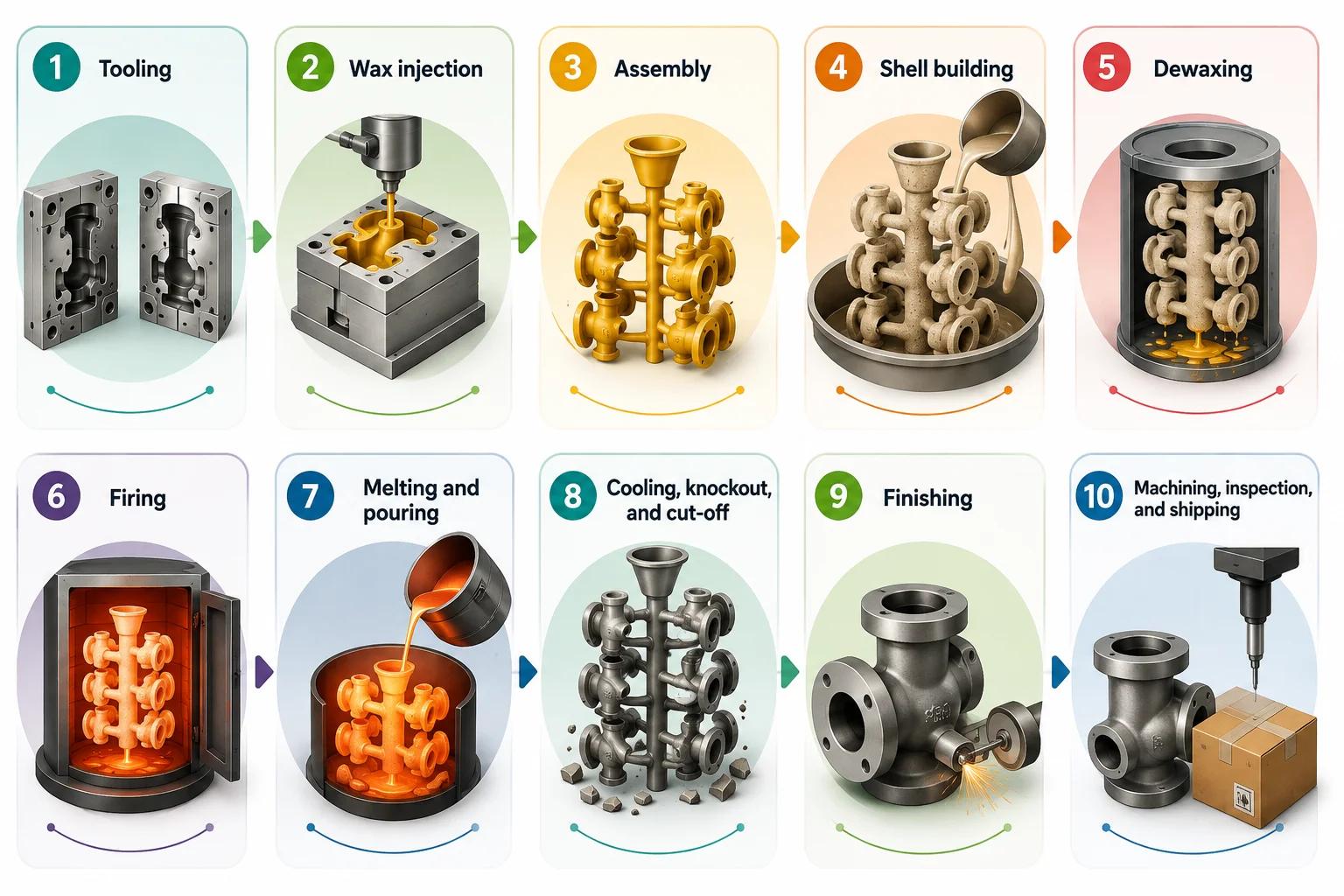
1. Tooling. A metal die is machined to produce the wax pattern. This is the biggest upfront cost and the longest lead item; expect six to ten weeks before the first wax is shot. Design-for-manufacturing review happens here, and changes are cheap now and expensive later.
2. Wax injection. Wax is injected into the die under pressure to produce a slightly oversized replica of the part, allowing for shrinkage of both the wax and the metal.
3. Assembly. Individual patterns are attached by hand to a central wax runner, forming a “tree.” A tree might carry a single 40-pound valve body or several dozen small fittings.
4. Shell building. The tree is dipped in ceramic slurry, coated with sand stucco, and dried, then dipped again with coarser stucco until the shell is thick enough to hold molten metal. Each coat needs drying time, so shell building alone takes several days.
5. Dewaxing. The shell goes into a steam autoclave, the wax melts out and is recovered, and a hollow ceramic mold remains.
6. Firing. The empty shell is heated to high temperature to burn out residual wax, cure the ceramic, and preheat the mold so metal flows fully into thin sections.
7. Melting and pouring. The alloy is melted, checked for chemistry, and poured into the hot shell.
8. Cooling, knockout, and cut-off. Once solidified, the shell is broken away by vibration or high-pressure water, and each casting is cut from the tree.
9. Finishing. Gates are ground flush, castings are shot blasted, and heat treatment sets the final mechanical properties.
10. Machining, inspection, and shipping. Where drawing tolerances are tighter than the as-cast standard, in-house CNC machining takes the critical features the rest of the way. Dimensional inspection on a CMM, plus any NDT the customer specifies, comes before packing.
Precimetal also runs three ways of forming internal passages that a standard shell can’t reach: water-soluble wax cores, a quick-set gel process for passages under 10 mm (about 3/8 in.) in diameter, and pre-formed ceramic cores for complex cavities such as EGR flow paths. Ask any prospective investment casting supplier about these, because internal geometry is usually why a part gets quoted as “not castable.”
What tolerances and surface finish should you expect?
The number most buyers know is ±0.005 in. per inch as the as-cast linear tolerance for investment casting, with an as-cast surface finish around 125 RMS (roughly 3.2 µm Ra). For comparison, sand casting typically runs ±0.030 to 0.060 in. per inch with a 250 to 500 RMS finish, and CNC machining from bar reaches ±0.001 in. per inch or better with a 32 to 125 RMS finish.
Two practical notes:
- Tolerance is not uniform across the part. Features formed by the die itself hold tighter than long, thin sections or features across a parting line. A good foundry will mark up your drawing to show which dimensions it holds as-cast and which it recommends machining.
- Standards differ by region. Precimetal quotes as-cast tolerances to IS 11166 and the German VDG P690 standard rather than to ISO 8062, so if your drawing calls out a CT grade, send it with the RFQ and ask the foundry to confirm the equivalent class in writing.
For size, industrial investment casting covers parts from a few grams to several hundred pounds, though most foundries specialize in a narrower band. Precimetal’s range runs to about 50 kg (110 lb) and a 600 mm (24 in.) envelope, which covers most pump and valve, automotive, and general engineering components.
Which metals can be investment cast?
Almost any alloy that can be melted and poured. In practice, stainless steel castings make up the largest share of what leaves a lost-wax foundry, because the process suits corrosion-resistant grades that are expensive to machine from solid.
Grades Precimetal pours regularly (the full alloy list is here):
- Austenitic stainless: 304, 304L, 316, 316L, 321, 347 (the ASTM A351 cast equivalents are CF8, CF3, CF8M, and CF3M)
- Martensitic and ferritic stainless: 410, 420, 431, 440 series; 409, 430, 439, 444
- Duplex and super duplex: 2205 and 2507, common in oil and gas valve body castings
- Carbon and low-alloy steel: WCB and WCC, AISI 1020 through 1095, 4130, 4140, 4340, 8620
- Heat- and creep-resistant grades: WC6, WC9, C12A
- Tool steels, cobalt alloys, and nickel-base superalloys on request
If your drawing specifies a wrought grade (say, 316L bar), note that the cast equivalent (CF3M) has slightly different chemistry limits. Ask the foundry to supply certified material test reports against the cast specification, not the wrought one.
When investment casting is the right choice, and when it isn’t
Choose investment casting when:
- The part has complex external shape, undercuts, or fine detail that would require multi-axis machining or multiple setups.
- You need a near-net shape in an alloy that is slow or costly to machine, such as 316 or duplex stainless.
- Annual volumes are in the hundreds to tens of thousands. The die is amortized over the run, and per-piece cost drops sharply once tooling is paid off.
- Surface finish matters for function or appearance and you want to skip secondary polishing.
Look elsewhere when:
- You need one to ten pieces and the geometry is simple. Tooling cost will dominate; machining or 3D-printed patterns are usually cheaper.
- The part is large and dimensionally forgiving. Sand casting will be cheaper per pound.
- The part has very thin walls over a large area or deep, narrow blind holes, which are hard to fill and hard to core. As a rule of thumb, cast holes should be no smaller than 1/16 in. and no deeper than about 1.5 times their diameter.
- Lead time is critical and no tooling exists. First articles from a new die are typically eight to twelve weeks out.
A typical example: when a customer moves a family of pump impellers from full machining to investment casting with finish machining on the hub and bore only, machining time per part drops sharply and the vanes come out more consistent than milled versions. The tradeoff is a one-time die cost and a longer first-article cycle.
What to send an investment casting manufacturer with your RFQ
Most of the back-and-forth on a casting quote comes from missing information, not from pricing. Sending the items below with your first email shortens quoting from days to hours.
- A 3D model plus a 2D drawing. STEP or IGES for the model; the drawing carries tolerances, datums, and finish callouts that a model doesn’t.
- Material specification and any certification required. ASTM A351 or A743 for stainless, A216 for carbon steel, and whether you need EN 10204 3.1 material certs.
- Annual volume and release quantity. Foundries price by the release, not the year. Precimetal, for example, sets a minimum of 150 kg (about 330 lb) per part per release.
- Quality system requirements. Ask which certifications are current, not just listed. ISO 9001 is the baseline; IATF 16949 matters for automotive, AS9100 for aerospace and defence. If you require PPAP, state the level.
- Inspection and testing. Dimensional report, NDT (dye penetrant, radiography), pressure test, or hardness check. Each adds cost and should be quoted separately.
- Landed-cost factors. Import duties on steel castings depend on the HTS classification of the finished part, and tariff rules have changed several times since 2025. Have your customs broker confirm the classification before you compare an overseas quote to a domestic one.
A responsive foundry will turn a complete RFQ around within a business day. Precimetal commits to 24 hours for a first response, signs NDAs on request, and treats every drawing as confidential.
Frequently asked questions about investment casting
Is investment casting the same as die casting?
No. Die casting forces molten metal into a permanent steel mold under high pressure and is mostly limited to low-melting-point alloys such as aluminum and zinc. Investment casting uses a single-use ceramic mold, works with steel, stainless, and superalloys, and handles undercuts and internal passages that a two-part die cannot release.
How accurate is investment casting?
The accepted as-cast baseline is about ±0.005 in. per inch (±0.1 mm on the first 25 mm), with a surface finish around 125 RMS. Critical features can be finish-machined to tighter limits; Precimetal machines to 20-micron tolerances in-house.
What is the minimum order quantity?
It varies by foundry. Precimetal sets a minimum of 150 kg (about 330 lb) per part number per release, which for a 1 kg valve body works out to about 150 pieces. Smaller trial quantities can usually be arranged once tooling exists.
How long does investment casting take?
For a new part, tooling takes six to ten weeks and first articles typically follow within eight to twelve weeks of order. Repeat production from existing tooling is faster, since the wax, shell, pour, and finishing cycle runs in a few weeks depending on quantity and post-processing.
Can investment castings be used for pressure-retaining parts?
Yes, provided the alloy and testing match the application. Pump housings and valve bodies are among the most common investment-cast pressure parts; specify pressure testing, radiography, or dye penetrant inspection on the drawing so it is quoted and performed.
Which industries use investment casting most?
Pumps and valves, automotive (exhaust and EGR components in particular), aerospace and defence, oil and gas, medical instruments, and general industrial machinery. See the industries and products Precimetal serves.
Conclusion
Investment casting is ideal for complex parts, difficult-to-machine alloys, and repeat production. While it may not suit small batches of simple components, it can deliver near-net shapes, consistent quality, and reduced machining costs. The choice depends on geometry, material, and production volume. If these factors favour casting, getting a quote before committing to machining can be worthwhile. Precimetal Cast, with engineering expertise since 2001, delivers high-quality precision castings for aerospace, automotive, and industrial applications, helping manufacturers achieve reliable performance, durability, and dimensional precision in demanding components.
Get a quote for your part
Have a drawing ready? Send it to Precimetal Cast with the six RFQ items above. You’ll get a first response within 24 hours, an honest answer on whether the part suits lost-wax casting, and, if it does, a quote covering tooling, per-piece price, and lead time. Drawings are held in confidence and we sign NDAs on request. Prefer to talk first? Call +91 76000 28290 or browse our capabilities to check alloy and size fit before you reach out.
Share This Article
Need Precision Castings?
We specialize in close-tolerance investment casting for automotive, aerospace, and general engineering applications.
GET A FREE QUOTE
