

How to Choose the Right Investment Casting Manufacturer for Your Component
Picking an investment casting manufacturer on price alone is a mistake most buyers make exactly once. A foundry can ship a good-looking sample and still turn out to be the expensive option after you add tooling, machining, inspection, scrap, freight, and the two shipments that arrived late.
The question worth asking is different: can this manufacturer make my part to the drawing, at the volume I need, month after month, at a total cost that makes sense? Answering it means looking past the per-piece casting quote.
This guide walks through what to check before you commit, including alloy capability, engineering support, tooling terms, tolerances and inspection, in-process quality control, total cost, and capacity. It also covers what to put in your RFQ so the quotes you get back are worth comparing.
Start with the component, not the supplier
Before you call anyone, be clear about why this part is a candidate for investment casting at all. The lost-wax process earns its keep when a component has some combination of:
- Complex or intricate geometry
- Thin walls or features that are awkward to machine
- Internal passages that are hard to produce any other way
- A near-net-shape requirement
- An alloy that is expensive to buy and slow to cut
- Several machined pieces that could be consolidated into one casting
A quick test: if the part is currently machined from bar or billet, how much of the raw material ends up as chips? When a large share of a 316L or duplex bar goes into the swarf bin, a casting with machining only on the critical faces will usually come out cheaper per piece.
Investment casting is not the answer for everything, though. A simple bracket in mild steel at 200 pieces a year is probably better fabricated or machined, and a large, dimensionally forgiving housing is often better sand cast. A manufacturer worth working with will tell you that instead of quoting the drawing as it came in.
Seven things to check before choosing an investment casting manufacturer
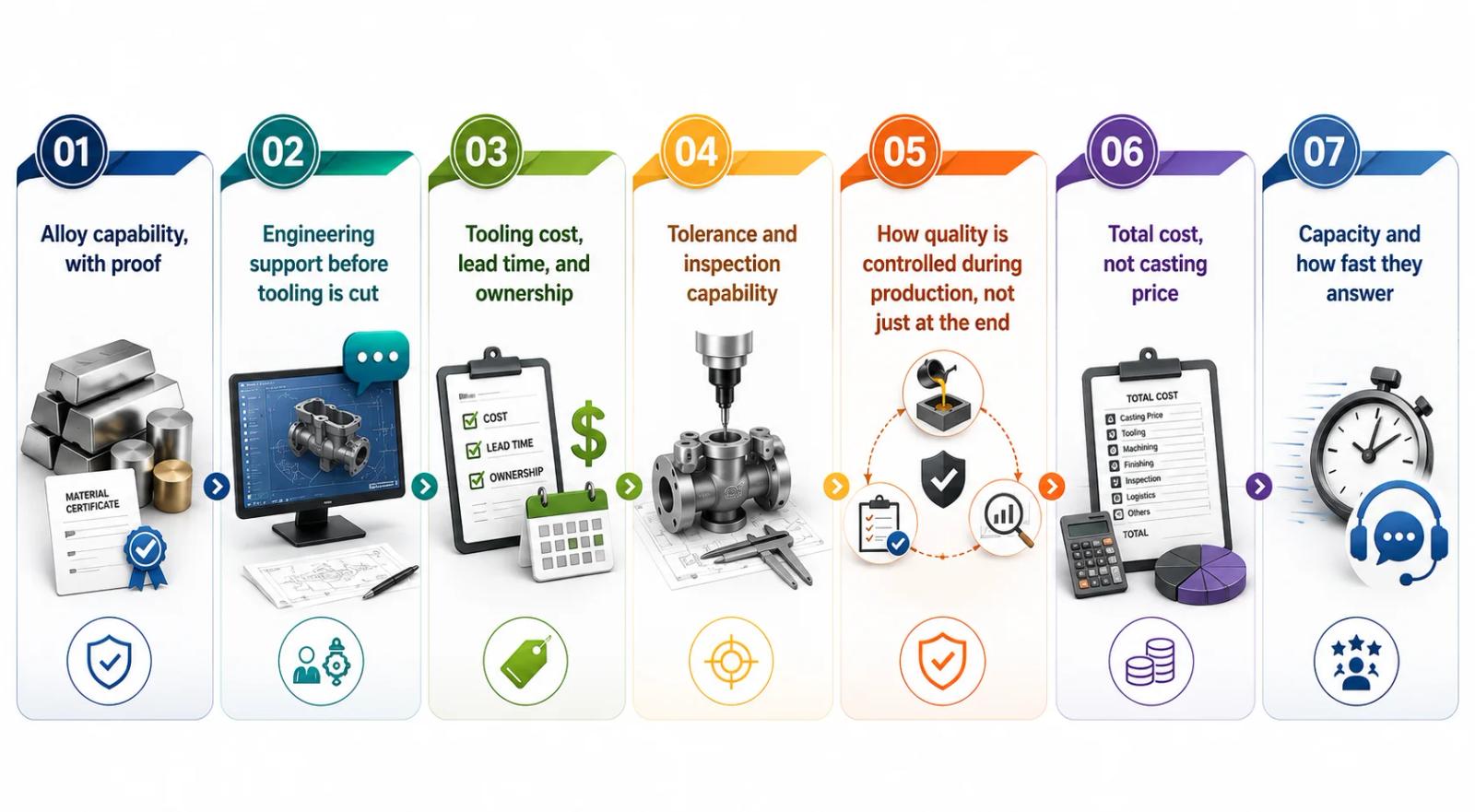
1. Alloy capability, with proof
Ask whether the foundry pours your alloy on a regular basis, and then keep asking. A “yes” is not enough. You want to know:
- Which specification they cast to (ASTM A351, A743, A216, EN 10213, or your own)
- How material is traced from heat number to shipped casting
- How melting and pouring are controlled, and whether chemistry is checked per heat
- Whether heat treatment is done in-house or sent out
- What material certification comes with the parts (a 3.1 cert against the cast grade, not the wrought one)
- Which similar components they have made in that alloy
This matters most for automotive, aerospace, and pressure-retaining industrial parts, where a chemistry drift shows up as a cracked casting or a failed hydrotest rather than a note on a report. If your drawing has a demanding material call-out, send the complete specification rather than a trade name. Precimetal’s alloy list covers austenitic, ferritic, martensitic, and duplex stainless, carbon and low-alloy steels, and heat-resistant grades such as WC6, WC9, and C12A, so you can check fit before you send a drawing.
2. Engineering support before tooling is cut
A good investment casting manufacturer gets involved in the design conversation before anyone machines a die. Expect them to raise questions such as:
- Where the parting line and gating should sit
- Which features are likely to cause shrinkage, misrun, or shell cracking
- Whether machining allowances can be reduced
- Whether wall sections are practical for the shell to fill
- Whether a small geometry change would make the part easier to cast
- Which tolerances actually need to be tight, and which are on the drawing by habit
This review is cheap. Fixing the same problems after the die exists is not. Precimetal runs a design-for-manufacturing check on every new part as step one of its process, and it is the stage where most quotes change the most.
3. Tooling cost, lead time, and ownership
Tooling is the largest single commercial variable in investment casting. Whether it makes sense depends entirely on how many parts you will run through it.
For a few dozen pieces, the die cost can kill the business case. For repeat production over several years, the same die is a rounding error per piece. Before you approve a quote, get clear answers on:
- Tooling price and what it includes (die, fixtures, gauges)
- Tooling lead time (Precimetal quotes six to ten weeks for a new die)
- Who owns the tool once it is paid for
- What a tool modification costs
- Expected tool life in shots
- How prototypes are handled (3D-printed patterns, soft tooling, or the production die)
- What an engineering change costs after the first sample
A manufacturer that is vague about these items at the quoting stage will not get clearer later.
4. Tolerance and inspection capability
Buyers choose investment casting for near-net shape, but near-net does not mean every dimension will hold a machining tolerance straight out of the shell. Ask the foundry to mark up your drawing and show which dimensions it will control as cast and which it recommends machining. Then ask which standard it casts to. Precimetal works to IS 11166 and VDG P690 for as-cast tolerances and machines critical features in its own CNC shop, so the answer for a given dimension is on the quote, not left to a phone call later.
Inspection should match the part, not the longest list you can think of. A dimensional report from a CMM, a visual check, a material test, or NDT such as dye penetrant or radiography each add cost. Specify the ones that verify something the part needs and drop the rest.
5. How quality is controlled during production, not just at the end
Final inspection catches defects. It does not prevent them. A repeatable investment casting process has controls at each stage, and a supplier audit should ask how they manage:
- Wax pattern consistency (injection parameters, pattern inspection)
- Ceramic shell quality (slurry viscosity, drying, layer count)
- Melting and pouring (temperature, chemistry per heat)
- Heat treatment records
- Casting defect rates and how they are tracked
- Finishing operations
- Dimensional inspection frequency
- Material traceability
- Final documentation
The difference between a foundry that can produce one good sample and one that can produce ten thousand is in these answers. Precimetal’s certifications include ISO 9001:2015, IATF 16949, and AS9100, and it supports PPAP at whatever level the customer requires, with full FMEA documentation for automotive work.
6. Total cost, not casting price
A lower casting quote does not mean a lower part cost. The number that matters is:
Total component cost = casting + tooling + machining + finishing + inspection + rejection and rework + logistics
A foundry with a slightly higher casting price can still win on total cost if its process needs less machining stock, holds dimensions more consistently, or scraps fewer parts. That is also the comparison to make against machining from bar, forging, or fabrication.
Ask every supplier to break the quote into tooling, casting, secondary operations, inspection, packaging, and transport as separate lines. Bundled quotes hide the differences you are trying to see.
7. Capacity and how fast they answer
A foundry can be technically capable and still be the wrong choice for your schedule. Ask about:
- Prototype lead time
- Production lead time from PO
- Monthly capacity in your alloy and size range
- Batch sizes and minimum order quantity
- Capacity during their peak season
- Which secondary operations are in-house
- Delivery planning and how they handle a pull-in
- Engineering change management
Pay attention to how the quoting stage goes. If questions about a tolerance or a material spec take a week to answer now, that will not improve once production starts. Precimetal commits to a first response within 24 hours on a complete RFQ, its shell room and dewax autoclaves are rated at 100 tonnes, and its heat treatment furnace handles 60 tonnes a month. Those figures tell you quickly whether your volume fits.
What to send an investment casting manufacturer
The quality of the quote depends on the quality of the RFQ. A complete package looks like this.
Component information: the 2D manufacturing drawing, a 3D model (STEP or IGES) where available, the part weight or an estimate, annual or batch quantity, required material, surface finish, and the critical dimensions and tolerances flagged.
Quality requirements: inspection requirements, material certification (3.1, 3.2), testing (hydro, NDT, hardness), any customer or industry specification that applies, and packaging requirements.
Commercial information: prototype quantity, expected annual volume, target schedule, delivery location, and the documentation you need with each shipment.
The clearer the package, the faster a manufacturer can tell you whether the part fits its process and price it properly. Precimetal accepts STP, STEP, IGS, IGES, SLDPRT, X_T, DWG, and DXF files through its quote request page.
Investment casting vs machining: which should you choose?
There is no universal answer. Investment casting tends to win when the geometry is complex, the part has features that are awkward to machine, a lot of material would otherwise become chips, repeat production justifies the die, and near-net shape cuts downstream work. Machining tends to win when the geometry is simple, quantities are very low, there is no real material saving, and tooling economics do not close.
For many parts the right answer is both: cast the complex near-net shape, then machine only the faces and bores that need tight control. That is how most pump and valve components and automotive exhaust parts are produced.
Questions to ask before selecting your supplier
- Can you cast the required alloy to our specification, and which cast grade will you certify to?
- Have you produced components with similar geometry? Can we see one?
- How will you review our design for manufacturability, and who does it?
- Which dimensions should be machined after casting?
- What inspection and testing can you provide in-house?
- What is included in the tooling quotation?
- Who owns the tooling?
- What quantity makes the process viable, and what is your minimum release?
- What documentation ships with the parts?
- What are the prototype and production lead times?
The answers say more than the casting price ever will.
Why engineering experience matters
Investment casting is a chain of dependent steps. A poor gating decision at the tooling stage shows up weeks later as porosity under a machined face. A wall section that is too thin shows up as a misrun. A tolerance that nobody questioned shows up as a machining operation that did not need to exist.
That is why supplier selection should weigh engineering involvement and process control alongside capacity. On demanding parts, bringing the foundry in early often reveals a simpler geometry, less machining, or a consolidated design before the die is committed. EGR components are a good example: the internal flow passages that make them hard to machine are exactly what ceramic cores and soluble wax cores handle well, but only if the passage design is reviewed before tooling.
Precimetal Cast: precision casting for demanding applications
Precimetal Cast has run a lost-wax foundry in Kadi, Gujarat, since 2001. The plant has 720 metric tons of annual capacity, an in-house CMM lab, a machine shop added in 2025, and pre-formed ceramic core capability integrated in 2018. It ships to customers in aerospace and defence, automotive, pumps and valves, and general engineering.
If you are evaluating investment casting for a complex or repeat-production part, send Precimetal the drawing, material specification, quantity, and key requirements. You will get a first response within 24 hours and a clear answer on whether the part suits the process.
Frequently asked questions
What is an investment casting manufacturer?
An investment casting manufacturer produces metal components using the investment casting process, in which a wax pattern is used to create a ceramic mould before the metal is cast. Manufacturers may also provide related services such as tooling, heat treatment, finishing, machining, and inspection.
How do I choose the right investment casting manufacturer?
Evaluate the manufacturer's alloy capability, engineering support, tooling process, quality controls, inspection capability, production capacity, lead times, and total component cost. Do not select a supplier based only on the initial casting quotation.
Is investment casting cheaper than machining?
It depends on the component. Investment casting can become economically attractive for complex geometries, difficult-to-machine alloys, and repeat production because it can reduce material removal and machining requirements. For simple, low-volume parts, machining may still be more economical.
How important is tooling in investment casting?
Tooling is an important part of the investment casting economics. The tooling investment needs to be considered against expected production volume, tooling life, component complexity, and potential future demand.
What information should I provide for an investment casting quotation?
Provide the component drawing, 3D model if available, material specification, quantity, tolerances, surface requirements, inspection requirements, testing requirements, and expected production schedule.
Can investment castings be machined after casting?
Yes. Investment castings can be supplied as near-net-shape components and subsequently machined where tighter tolerances or specific surface requirements are necessary.
When should I contact an investment casting manufacturer?
Ideally, involve the manufacturer during the design or sourcing stage. Early technical review can identify manufacturability concerns and help determine whether investment casting is commercially and technically appropriate.
Final takeaway
The right investment casting manufacturer gives you more than a competitive quote. Material expertise, engineering input, process control, inspection capability, transparent tooling terms, and consistent delivery all affect what the part finally costs and how it performs.
For complex, repeat-production components, checking these points before you place the order is far cheaper than changing supplier after the first batch. Precimetal Cast has worked this way with aerospace, automotive, and industrial customers since 2001. Send a drawing and find out whether your part is a fit.
Share This Article
Need Precision Castings?
We specialize in close-tolerance investment casting for automotive, aerospace, and general engineering applications.
GET A FREE QUOTE
