

Oil and Gas Investment Casting: NACE MR0175 Materials
Oil and gas components can face a difficult combination of pressure, temperature, corrosive fluids and, in sour service, hydrogen sulfide (H₂S). For cast components such as valve bodies, valve trim, pump housings and manifold blocks, choosing an appropriate alloy is therefore more than simply selecting a corrosion-resistant stainless steel.
NACE MR0175/ISO 15156 provides requirements and recommendations for selecting and qualifying metallic materials for H₂S-containing environments in oil and gas production. The standard does not mean that one alloy is universally suitable for every sour-service application. Material suitability depends on the actual service environment and applicable requirements. For engineers and procurement teams sourcing oil and gas investment castings, the practical question is:
How do you connect the service conditions, material specification and casting requirements before placing an order?
This guide explains the key considerations, with particular attention to CF8M valve castings, duplex stainless steel castings and sour-service applications.
What Is Oil and Gas Investment Casting?
Oil and gas investment casting is a lost-wax manufacturing process used to produce complex metal components with detailed geometries and controlled dimensional accuracy.
The process is particularly useful for components such as:
- Valve bodies
- Valve seats and trim
- Pump impellers
- Pump housings
- Manifold blocks
- Wellhead components
- Flange-related components
Investment casting creates the component close to its final geometry, reducing the amount of machining required for complex shapes.
For example, a valve body may contain curved flow passages, pockets, sealing areas and other features that would require multiple machining operations if produced entirely from billet.
Precimetal's oil and gas investment casting capabilities cover components designed for demanding flow-control and process applications.
Why Material Selection Matters in Sour Service
The presence of H₂S changes the material-selection equation.
In certain oil and gas environments, H₂S can contribute to cracking mechanisms including sulfide stress cracking (SSC), hydrogen-induced cracking (HIC), stress corrosion cracking and other hydrogen-related mechanisms. ISO 15156 addresses these risks through requirements for material selection and qualification.
This means that selecting a material simply because it has good general corrosion resistance is not enough.
A material specification for a sour-service casting should be considered alongside factors such as:
- H₂S exposure
- Temperature
- Pressure
- Environmental chemistry
- pH
- Chloride conditions
- Material condition
- Heat treatment
- Hardness requirements where applicable
- Casting specification
- Applicable design and procurement standards
The important distinction is this: an alloy grade and a sour-service qualification are not automatically the same thing.
What Is NACE MR0175 / ISO 15156?
NACE MR0175/ISO 15156 is the internationally recognized framework associated with metallic materials used in H₂S-containing oil and gas production environments.
The ISO 15156 series addresses material selection and qualification for equipment exposed to H₂S-containing environments. The current published ISO framework includes:
- ISO 15156-1: general principles and material/material-processing requirements
- ISO 15156-2: carbon and low-alloy steels and associated material selection requirements
- ISO 15156-3: corrosion-resistant alloys and other alloys
ISO's current catalogue lists ISO 15156-1:2020, ISO 15156-2:2020 and ISO 15156-3:2020 as published standards, while fifth-edition drafts are currently under development.
The standard is specifically concerned with H₂S-containing environments and cracking risks. It does not replace the design code, casting specification or other requirements applicable to the component.
A practical point for buyers
When a drawing or purchase specification says "NACE MR0175", the foundry should not treat this as just another material grade.
The supplier needs the relevant service and material requirements to determine whether the proposed material and processing route are appropriate.
Which Materials Are Used for Oil and Gas Investment Castings?
There is no single universal material for oil and gas castings.
The selection depends on the application, service environment, mechanical requirements and applicable specification.
For investment casting, common alloy families include:
Material family | Example grades | Typical consideration | |
Austenitic stainless steel | CF8M, CF3M | Corrosion-resistant valve and fluid-handling components | |
Duplex stainless steel | 2205 | Strength and corrosion resistance | |
Super duplex stainless steel | 2507 | More demanding corrosion environments | |
Carbon steel | WCB, WCC | Applications where carbon steel meets service requirements | |
Low-alloy steel | Various grades | Applications requiring specific mechanical properties |
Precimetal's investment casting capabilities include 2205 and 2507 duplex/super duplex grades, as well as a range of stainless, carbon and alloy steels.
However, material availability should not be interpreted as automatic suitability for a particular sour-service application. The selected grade must be checked against the applicable ISO 15156 requirements and the actual service conditions.
CF8M Valve Castings for Oil and Gas Applications
CF8M is a cast austenitic stainless steel commonly used for fluid-handling components such as valve bodies, pump housings and related components.
It is the cast counterpart commonly associated with wrought 316 stainless steel, but CF8M and 316 should not simply be treated as interchangeable specifications. CF8M is a cast grade with its own chemistry and applicable casting standards.
Precimetal's technical material information identifies CF8M as a common grade for valve bodies, pump housings, fittings and other fluid-handling components.
Where CF8M can make sense
CF8M can be considered when a component requires:
- Austenitic stainless steel
- Molybdenum-containing corrosion resistance
- Complex cast geometry
- Near-net-shape manufacturing
- Reduced machining compared with machining from solid stock
For example, a complex valve body with internal flow passages may be a strong candidate for investment casting because the geometry can be formed during the casting process rather than created entirely through machining.
However, CF8M should not be specified for sour service solely because it is corrosion resistant. Its suitability needs to be established against the applicable service conditions and ISO 15156 requirements.
For more detail, see Precimetal's guide to CF8M investment castings.
Duplex Stainless Steel Casting for Sour Service
Duplex stainless steels combine an austenitic-ferritic microstructure and are used where a combination of strength and corrosion resistance is required.
Two grades commonly encountered in investment casting are:
- Duplex 2205
- Super duplex 2507
Precimetal lists both 2205 and 2507 within its investment casting material capabilities.
For oil and gas components, duplex and super duplex grades can be relevant to applications involving demanding corrosion conditions.
But again, the phrase "duplex stainless steel" does not automatically mean "NACE compliant."
For a sour-service component, the engineer needs to verify:
- The exact alloy grade
- Applicable ISO 15156 requirements
- Service environment
- Heat treatment condition
- Mechanical and hardness requirements
- Any project-specific requirements
- Required inspection and certification
This distinction is especially important when specifying sour service castings for pressure-containing equipment.
NACE MR0175 Castings: What Should Be Checked?
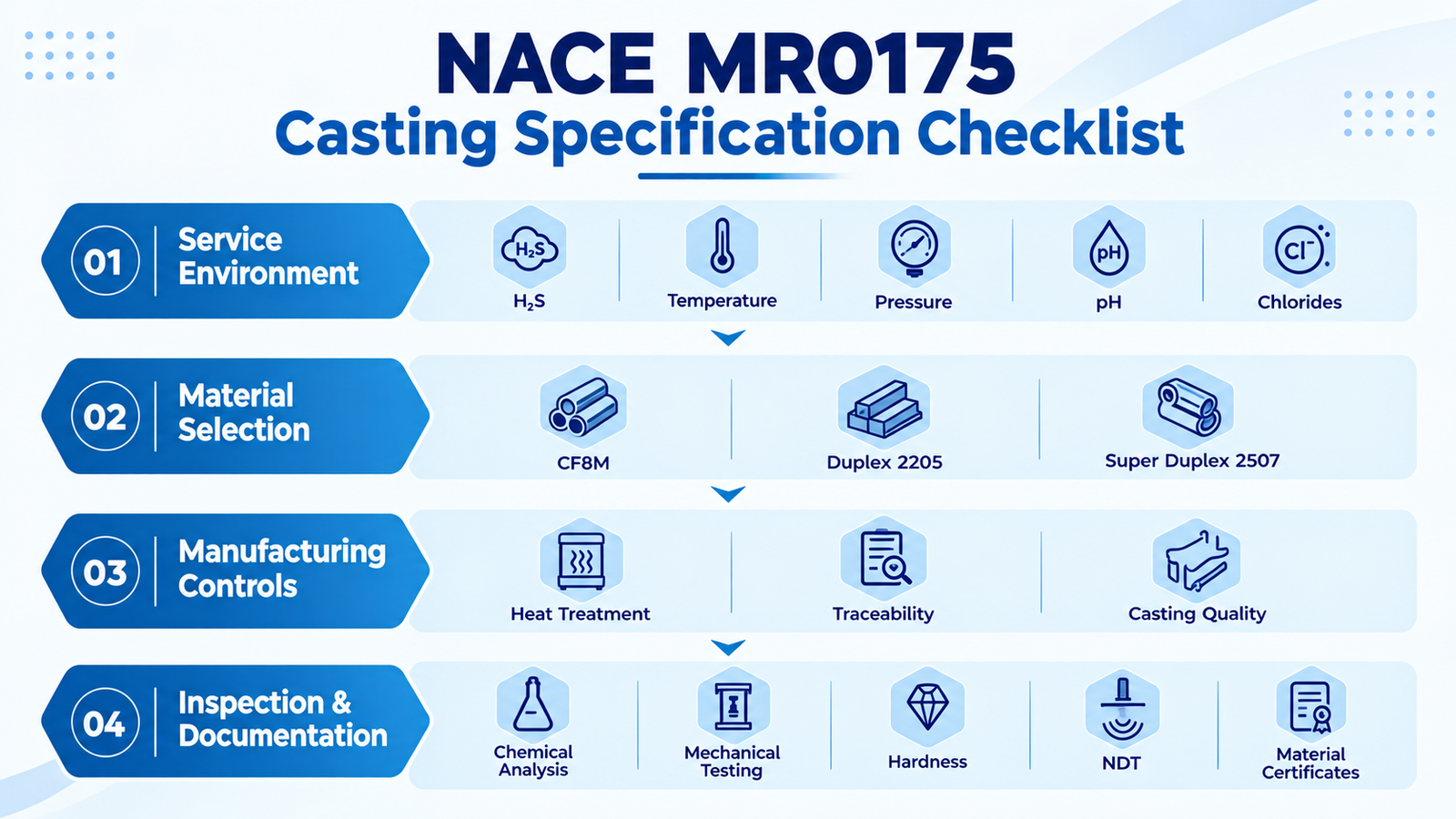
When purchasing NACE MR0175 castings, the material grade is only one part of the specification.
A useful purchasing checklist includes:
1. Component application
Clearly identify what the casting will do.
For example:
- Valve body
- Valve trim
- Pump housing
- Manifold
- Wellhead component
2. Service environment
Provide the available service information, including:
- H₂S exposure
- Temperature
- Pressure
- Fluid composition
- pH
- Chlorides and other relevant environmental factors
3. Material specification
State the required casting grade and applicable material standard rather than simply writing "stainless steel."
4. Heat treatment
The required heat-treatment condition should be clearly defined and verified against the applicable material specification.
5. Inspection requirements
Depending on the application, the purchase specification may require chemical analysis, mechanical testing, hardness verification, dimensional inspection, NDT or other inspection activities.
6. Documentation
For critical components, the buyer should define the required material certificates, heat/lot traceability and inspection documentation before production starts.
This reduces ambiguity between the end user, engineering team, procurement department and foundry.
Investment Casting Process for Oil and Gas Components
Material selection is only part of producing a reliable casting.
The manufacturing process also needs appropriate control.
A typical investment casting workflow includes:
Tooling → Wax Pattern → Pattern Assembly → Ceramic Shell → Dewaxing → Shell Firing → Melting & Pouring → Solidification → Knockout → Fettling → Heat Treatment → Inspection → Machining → Final Inspection
Precimetal follows a structured 15-step investment casting process, including tooling development, wax injection, ceramic shell building, controlled melting and pouring, finishing and inspection.)
For complex oil and gas components, casting design also matters.
Internal passages, wall thickness, machining allowances, gates, cores and inspection access should be considered before tooling is finalized.
This is why an engineering review before production can prevent problems later in the manufacturing cycle.
What Makes a Good Sour-Service Casting Specification?
A good specification gives the foundry enough information to manufacture and verify the casting correctly.
Instead of:
"Supply NACE-compliant stainless steel valve casting."
A more useful specification identifies:
- Component drawing and revision
- Casting material grade
- Applicable material standard
- Service conditions
- H₂S/sour-service requirements
- Heat-treatment requirements
- Mechanical properties
- Hardness requirements where applicable
- NDT requirements
- Dimensional requirements
- Surface-finish requirements
- Inspection documentation
- Traceability requirements
The exact requirements will vary by component and project.
The goal is to connect the material specification to the actual service condition rather than treating NACE MR0175 as a standalone material label.
Common Mistakes When Specifying Oil and Gas Castings
Mistake 1: Treating "NACE" as a material grade
NACE MR0175/ISO 15156 is a material-selection and qualification framework for specific H₂S-containing environments. It is not a replacement for the actual alloy specification.
Mistake 2: Assuming stainless steel is automatically suitable for sour service
Stainless steel grades have different compositions, microstructures and application limits. Suitability depends on the applicable requirements and environment.
Mistake 3: Using a wrought specification for a casting
For example, 316 and CF8M are related but are not simply the same procurement specification.
The casting should be specified against the appropriate cast material standard.
Mistake 4: Ignoring heat treatment
Material condition can affect the final properties of a casting. Heat treatment requirements should therefore be established before production.
Mistake 5: Providing incomplete service information
Without information about the operating environment, the foundry cannot reliably determine whether a proposed material is appropriate for the intended sour-service application.
How to Choose an Oil and Gas Investment Casting Manufacturer
For critical oil and gas components, evaluate more than the alloy list.
Look for a manufacturer that can demonstrate:
- Relevant investment casting experience
- Controlled melting and pouring
- Appropriate heat-treatment capability
- Material traceability
- Dimensional inspection
- NDT capability where required
- Machining support
- Quality documentation
- Engineering and DFM support
- Experience with complex valve and fluid-handling components
Precimetal has been manufacturing investment castings since 2001 and lists stainless steel, duplex/super duplex, carbon steel and alloy steel among its casting capabilities. Its component portfolio includes oil and gas applications such as valve bodies, wellhead components, flange connections, pump housings and manifold blocks.
You can explore the company's investment casting capabilities to review available materials, dimensional capabilities and quality processes.
FAQ: NACE MR0175 and Oil and Gas Investment Casting
What is NACE MR0175?
NACE MR0175 is the designation historically associated with requirements for selecting and qualifying metallic materials for H₂S-containing oil and gas production environments. It is used together with the ISO 15156 framework for sour-service material selection.
Is ISO 15156 the same as NACE MR0175?
The NACE MR0175 and ISO 15156 documents were developed as technically aligned standards for materials used in H₂S-containing oil and gas production environments. ISO 15156 is the ISO designation within this framework.
Is CF8M suitable for sour service?
CF8M may be considered for applications where its material properties and the applicable requirements make it suitable, but CF8M alone does not establish sour-service suitability. The actual environment and applicable ISO 15156 requirements must be evaluated.
Is duplex stainless steel suitable for NACE MR0175 applications?
Duplex grades such as 2205 and 2507 can be relevant to demanding oil and gas applications, but suitability depends on the specific grade, material condition and service environment. The applicable ISO 15156 requirements should be checked for the intended application.
What are common oil and gas investment castings?
Common components include valve bodies, valve trim, pump housings, impellers, manifold blocks, wellhead components and flange-related components. Precimetal specifically lists these types of components within its oil and gas casting portfolio.
What information should I provide when requesting a sour-service casting?
Provide the component drawing, material specification, service conditions, H₂S information, operating temperature and pressure, applicable standards, heat-treatment requirements and inspection/documentation requirements.
Final Takeaway
For oil and gas investment casting, material selection should begin with the service environment, not simply the alloy name.
NACE MR0175/ISO 15156 provides a framework for selecting and qualifying materials for H₂S-containing oil and gas environments. Grades such as CF8M, duplex 2205 and super duplex 2507 can be relevant to oil and gas castings, but their suitability must be evaluated against the specific service conditions and applicable requirements.
For buyers and engineers, the most useful approach is to define the service environment + material grade + casting specification + heat treatment + inspection requirements before production begins.
If you are developing a valve body, pump component, manifold or other complex oil and gas casting, contact Precimetal Cast for an investment casting requirement review.
Share This Article
Need Precision Castings?
We specialize in close-tolerance investment casting for automotive, aerospace, and general engineering applications.
GET A FREE QUOTE
