

CF8 vs CF8M vs CF3 vs CF3M: Choosing the Right ASTM A351 Grade
CF8 material is the cast form of 304 stainless steel: 18 to 21% chromium, 8 to 11% nickel, carbon up to 0.08%, and no deliberate molybdenum. Its three close relatives under ASTM A351 differ in only two ways. Adding 2 to 3% molybdenum turns CF8 into CF8M (cast 316). Cutting carbon from 0.08% to 0.03% turns CF8 into CF3 (cast 304L) and CF8M into CF3M (cast 316L). Every selection decision between the four comes down to those two questions: does the part need molybdenum, and does it need low carbon?
This guide puts the four grades side by side, explains what each difference does in service, and gives a decision path that works for valve bodies, pump parts, fittings, and general engineering castings.
The four grades at a glance
CF8 | CF3 | CF8M | CF3M | ||
Wrought equivalent | 304 | 304L | 316 | 316L | |
UNS | J92600 | J92500 | J92900 | J92800 | |
EN grade | 1.4308 | 1.4306 | 1.4408 | 1.4409 | |
Carbon, max % | 0.08 | 0.03 | 0.08 | 0.03 | |
Chromium % | 18.0 to 21.0 | 17.0 to 21.0 | 18.0 to 21.0 | 17.0 to 21.0 | |
Nickel % | 8.0 to 11.0 | 8.0 to 12.0 | 9.0 to 12.0 | 9.0 to 13.0 | |
Molybdenum % | 0.50 max | 0.50 max | 2.0 to 3.0 | 2.0 to 3.0 | |
Tensile, min | 485 MPa (70 ksi) | 485 MPa (70 ksi) | 485 MPa (70 ksi) | 485 MPa (70 ksi) | |
Yield, min | 205 MPa (30 ksi) | 205 MPa (30 ksi) | 205 MPa (30 ksi) | 205 MPa (30 ksi) | |
Elongation, min | 35% | 35% | 30% | 30% |
Composition per ASTM A351; manganese 1.50% max, phosphorus and sulfur 0.040% max in all four. Silicon is 2.00% max for CF8 and CF3, 1.50% max for CF8M and CF3M.
The first thing to notice is that the strength minimums are the same. Nobody should choose between these grades for strength. The choice is about corrosion, welding, temperature, and cost.
What molybdenum does: CF8 vs CF8M
Molybdenum is the difference between a casting that survives chlorides and one that does not. Chromium gives all four grades their passive oxide film. Chloride ions attack that film locally and start pits; molybdenum makes the film far harder to break down. A common way to compare the effect is the pitting resistance equivalent number (PREN = %Cr + 3.3 × %Mo + 16 × %N). A typical CF8 heat lands around 19 to 21; a typical CF8M heat lands around 26 to 30. That gap is why CF8M is the default for seawater, brackish cooling water, de-icing salt exposure, and most chemical process streams, while CF8 is fine for fresh water, food, beverage, and dry indoor service.
The price of that protection is molybdenum itself, which is one of the more expensive alloying elements. A CF8M casting typically costs more than the same part in CF8, with the gap moving as molybdenum and nickel prices move. [Placeholder: insert Precimetal’s current typical price differential between CF8 and CF8M, confirmed by sales.] For a water-treatment valve that will see chlorinated water for twenty years, that premium is trivial. For a bracket inside a dry enclosure, it is money spent on nothing.
What low carbon does: CF8 vs CF3, CF8M vs CF3M
When an austenitic stainless is held between roughly 425 and 850°C, carbon combines with chromium to form chromium carbides at the grain boundaries. The metal next to each boundary is left short of chromium and loses its corrosion resistance. The condition is called sensitization, and in service it shows up as intergranular corrosion: the casting looks fine on the surface and then cracks along grain boundaries.
Solution annealing (1040°C minimum followed by a fast quench, required by A351 for all four grades) dissolves those carbides and puts the casting in a safe condition. The problem is what happens afterward. Field welding, a hot-work repair, or long service above about 425°C can put the part back into the sensitization range with no re-anneal to follow. That is where the L grades earn their place. At 0.03% carbon there is simply not enough carbon to form a damaging network of carbides, so CF3 and CF3M can be welded without post-weld heat treatment and stay resistant.
The cost of low carbon is small in material terms, but the foundry has to control the melt more tightly, and tensile strength typically comes out a little lower even though the A351 minimums are the same. Specify an L grade when welding or high-temperature exposure is part of the part’s life. If it will be shipped fully annealed, machined, and bolted in place, the standard grade is the sensible choice.
A decision path that works on real drawings
Answer two questions about the part’s service, in this order.
Will the part see chlorides, seawater, acids, or an aggressive process fluid? If yes, you need molybdenum: CF8M or CF3M. If no, CF8 or CF3 will do.
Will the part be welded after it leaves the foundry, or run above about 425°C for long periods? If yes, you need low carbon: CF3 or CF3M. If no, CF8 or CF8M.
That gives one of four answers:
• Dry or fresh-water service, no field welding: CF8. This is the workhorse for food equipment, brewery fittings, pump parts on potable water, and general engineering castings indoors.
• Fresh-water service, field welded: CF3. Less common than the other three, mainly used where a fabricator will weld cast fittings into a 304L pipe system.
• Chloride or chemical service, no field welding: CF8M. The single most specified grade for pump and valve castings in water treatment, marine, chemical, and oil and gas.
• Chloride or chemical service, field welded or hot service: CF3M. Standard for weld-end valves, pump casings welded to 316L pipe, and marine hardware that gets repaired in the field.
Two edge cases worth knowing. Nitric acid service prefers CF3 or CF8 over the molybdenum grades, because molybdenum is not helpful in strongly oxidizing acids. And for hot chloride service above about 60°C where stress corrosion cracking is the concern, none of the four may be enough; a duplex grade such as CD4MCuN or cast 2205 is the next step, and Precimetal pours those as well (duplex and super duplex are on the alloy list).
Three specification mistakes that cause problems
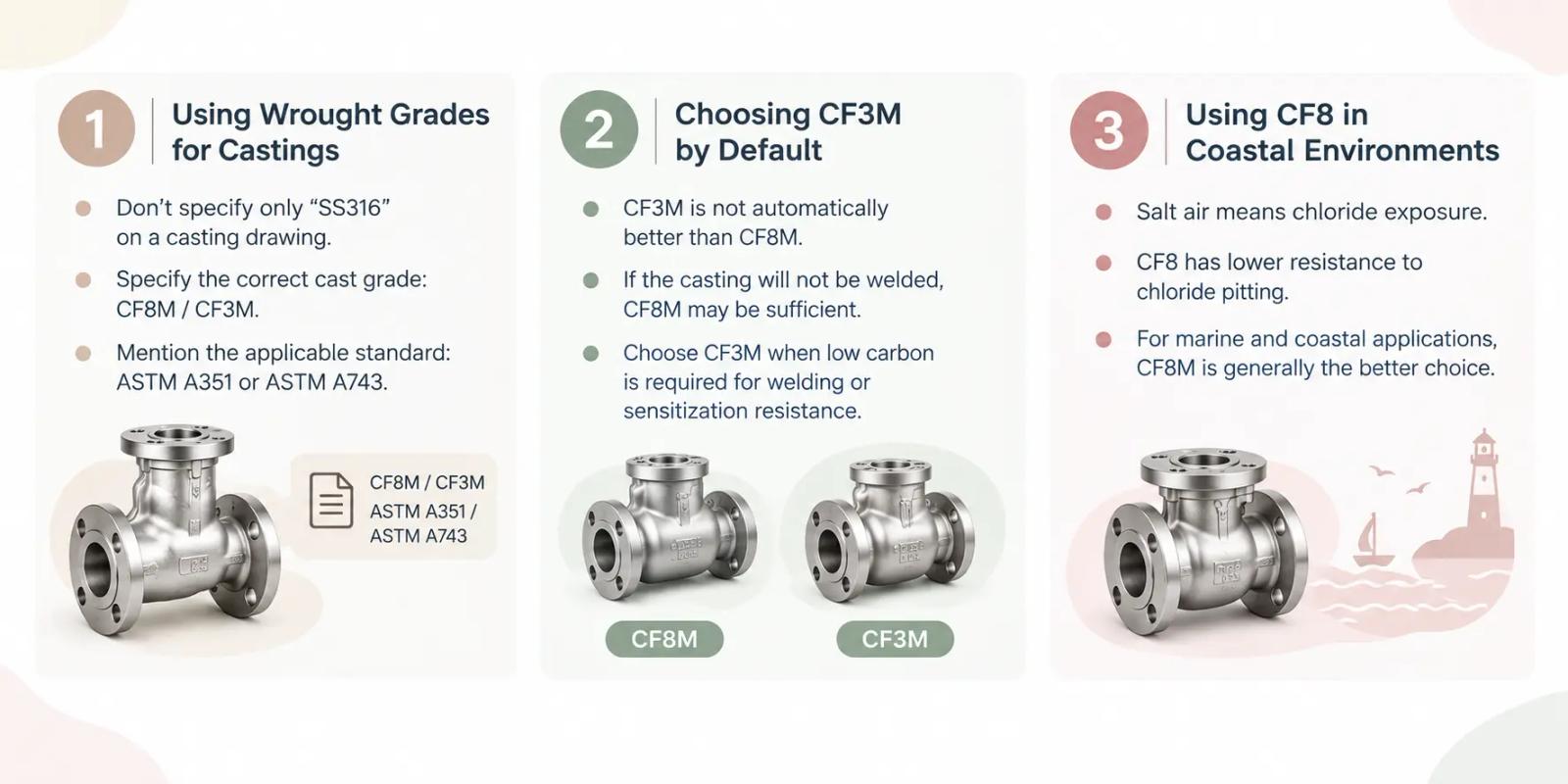
The first is writing a wrought grade on a casting drawing. A drawing that says “SS316” leaves the foundry to interpret whether you want CF8M or CF3M, and it leaves the certificate open to challenge because ASTM A240 (the wrought spec) does not apply to castings. Write the cast grade and the cast specification: “CF8M per ASTM A351” for pressure parts or “CF8M per ASTM A743” for general service.
The second is defaulting to CF3M for everything. Buyers do this because 316L is what they see on plate and pipe. On a fully annealed casting that will not be welded, CF3M brings no benefit over CF8M, costs slightly more, and narrows the pool of foundries that keep the melt in stock.
The third is specifying CF8 for outdoor coastal equipment. Salt air is a chloride environment. A CF8 casting on a dock or a coastal plant will develop pitting and tea-staining within a year or two. CF8M is the minimum for anything within a few kilometers of the sea.
How the four grades cast and machine
All four are austenitic and behave similarly in the foundry. They pour well in investment casting, fill thin sections, and take a good as-cast finish. All four contain some ferrite in the cast condition (typically 5 to 20%), which helps resist hot tearing during solidification and gives the casting a slight magnetic response that surprises some customers. Precimetal casts all four through the same 15-step lost-wax process, with solution annealing in-house and CMM inspection before dispatch.
Machining is where the grades behave slightly differently. All austenitic stainless work-hardens quickly, so sharp tooling, positive rake, and consistent feed matter more than grade choice. The molybdenum grades are marginally tougher on tooling than CF8 and CF3. If your part has tight-tolerance bores or sealing faces, the in-house CNC machining that follows casting is priced per grade, so tell the foundry which faces need machining at the RFQ stage.
Frequently asked questions
What is CF8 material?
CF8 is a cast austenitic stainless steel with 18 to 21% chromium, 8 to 11% nickel, and 0.08% maximum carbon, specified under ASTM A351 and A743. It is the casting equivalent of wrought 304 stainless, UNS J92600, EN 1.4308.
What is the difference between CF8 and CF8M?
Molybdenum. CF8M contains 2 to 3% molybdenum and CF8 contains none by design. That gives CF8M much better resistance to pitting and crevice corrosion in chlorides. Strength minimums are the same.
What is the difference between CF8M and CF3M?
Carbon. CF8M allows 0.08% carbon, CF3M allows 0.03%. CF3M resists sensitization after welding or high-temperature exposure, so it is chosen for weld-end parts and hot service. Corrosion resistance in the annealed condition is the same.
Is CF3 the same as 304L?
CF3 is the cast equivalent of wrought 304L. The compositions are similar but not identical, and castings should be specified as CF3 to ASTM A351 or A743, not as 304L.
Which grade is cheapest?
CF8. CF3 costs about the same or slightly more. CF8M and CF3M cost more because of molybdenum, and CF3M is usually the most expensive of the four.
Are these grades magnetic?
Slightly. All four contain some ferrite in the cast condition, so a magnet will show a weak pull. This is normal for cast austenitic stainless and does not indicate the wrong alloy.
Can all four grades be investment cast?
Yes. CF8, CF3, CF8M, and CF3M are among the most common alloys in stainless steel investment casting, used for valve bodies, impellers, fittings, and housings.
Conclusion
Choosing between CF8, CF3, CF8M, and CF3M depends on the casting’s service environment, welding requirements, and operating temperature. CF8 suits general applications, CF3 is preferred where low carbon is needed for welding, CF8M offers improved chloride resistance, and CF3M combines both benefits. Before finalizing a grade, share your drawing, service medium, temperature, and welding requirements with Precimetal Cast. Our team can help identify the suitable ASTM grade and provide casting, heat treatment, machining, inspection, and quotation support for your application.
Get the right grade quoted
If you are sourcing castings in any of these four grades and are not sure which fits, send Precimetal the drawing and a line about the service conditions. We pour all four, plus duplex and super duplex, in Kadi, Gujarat, with solution annealing, CMM inspection, and machining in-house, and we have supplied pump and valve and industrial customers since 2001. You will get a first response within 24 hours with a grade recommendation, tooling and per-piece pricing, and lead time.
Share This Article
Need Precision Castings?
We specialize in close-tolerance investment casting for automotive, aerospace, and general engineering applications.
GET A FREE QUOTE
