

CF8M Material: Composition, Properties, Equivalents and ASTM A351 Explained
CF8M is a cast austenitic stainless steel containing about 19% chromium, 10% nickel, and 2 to 3% molybdenum, with carbon held to 0.08% maximum. It is the casting grade that corresponds to wrought 316 stainless, and it is specified under ASTM A351 for pressure-containing parts and ASTM A743 for general corrosion-resistant service. Its UNS number is J92900 and its closest European equivalent is EN 1.4408 (GX5CrNiMo19-11-2).
If you buy valve bodies, pump housings, fittings, or marine hardware, CF8M is probably the grade on more of your drawings than any other stainless. This CF8M material guide covers what is in the alloy, how it performs, which standards govern it, how it maps to 316 and to European grades, and how to decide between CF8M, CF8, and CF3M for a given part.
What the name CF8M means
The designation comes from the Alloy Casting Institute (ACI) system, which ASTM adopted. The first letter, C, marks a corrosion-resistant alloy (H would mean heat-resistant). The second letter places the alloy on the iron-chromium-nickel diagram; F sits in the austenitic 18-8 region. The number is the maximum carbon content in hundredths of a percent, so 8 means 0.08%. The trailing M indicates molybdenum. Read together, CF8M is “corrosion-resistant austenitic, 0.08% carbon max, with molybdenum,” which is exactly what 316 is on the wrought side.
That naming logic makes the related grades easy to decode. CF8 is the same alloy without molybdenum (cast 304). CF3M holds carbon to 0.03% (cast 316L). CF3 is cast 304L.
CF8M composition per ASTM A351
Element | CF8M (ASTM A351 / A743) | Wrought 316 (ASTM A240) | |
Carbon | 0.08 max | 0.08 max | |
Chromium | 18.0 to 21.0 | 16.0 to 18.0 | |
Nickel | 9.0 to 12.0 | 10.0 to 14.0 | |
Molybdenum | 2.0 to 3.0 | 2.0 to 3.0 | |
Manganese | 1.50 max | 2.00 max | |
Silicon | 1.50 max | 0.75 max | |
Phosphorus | 0.040 max | 0.045 max | |
Sulfur | 0.040 max | 0.030 max |
All values in weight percent. Balance iron.
Two differences from wrought 316 are worth understanding because they explain why CF8M behaves the way it does. The chromium range is higher and the nickel range is lower. That balance is deliberate: it produces a small amount of delta ferrite in the cast microstructure, usually between 5 and 20%, which wrought 316 does not have. Ferrite in a casting is a good thing. It reduces hot-cracking during solidification, improves weldability for repair, and raises resistance to chloride stress corrosion cracking. It also makes the casting slightly magnetic, which surprises buyers who expect 316 to be fully non-magnetic. If a customer runs a magnet across a CF8M valve body and it sticks lightly, the alloy is behaving normally.
The wider silicon allowance improves fluidity so the metal fills thin sections of a ceramic shell. That is one reason cast and wrought specifications are written separately, and why a drawing should call out the cast grade rather than “316” when the part is a casting.
Mechanical properties of CF8M
ASTM A351 sets minimum values for CF8M in the solution-annealed condition:
- Tensile strength: 485 MPa (70 ksi) minimum
- Yield strength (0.2% offset): 205 MPa (30 ksi) minimum
- Elongation in 50 mm: 30% minimum
- Typical hardness: 130 to 180 HBW
- Density: about 7.8 g/cm³
Typical as-produced values sit comfortably above the minimums. On heat lots tested at Precimetal, tensile results in the 520 to 560 MPa range and elongation above 40% are normal for properly annealed CF8M.
The service temperature ceiling under ASME rules is about 538°C (1000°F). Above roughly 425°C, the 0.08% carbon can precipitate as chromium carbides at grain boundaries over long exposure, which is why CF3M is chosen for parts that see sustained heat or for weld-heavy assemblies that will not be re-annealed.
Heat treatment: why solution annealing is not optional
Every CF8M casting supplied to A351 must be solution annealed: heated to 1040°C (1900°F) minimum, held long enough to dissolve carbides, then quenched in water or cooled fast enough to prevent them re-forming. Skipping or under-running this step is the most common reason a CF8M part fails a corrosion test or shows intergranular attack in service.
On the shop floor the failure mode is usually not a skipped cycle but a slow quench on a heavy section. A 40 kg valve body pulled from the furnace and left to air cool for a minute before it reaches the quench tank can pass through the sensitization range on the way down. Precimetal’s heat treatment furnace is sized at 60 tonnes per month, and the procedure fixes transfer time so the section thickness, not the operator, decides the schedule. If your application is corrosion-critical, ask the foundry for the furnace chart with the certificate, and consider adding an ASTM A262 Practice E intergranular corrosion test on the first article.
ASTM A351 vs A743 vs A744: which CF8M are you buying?
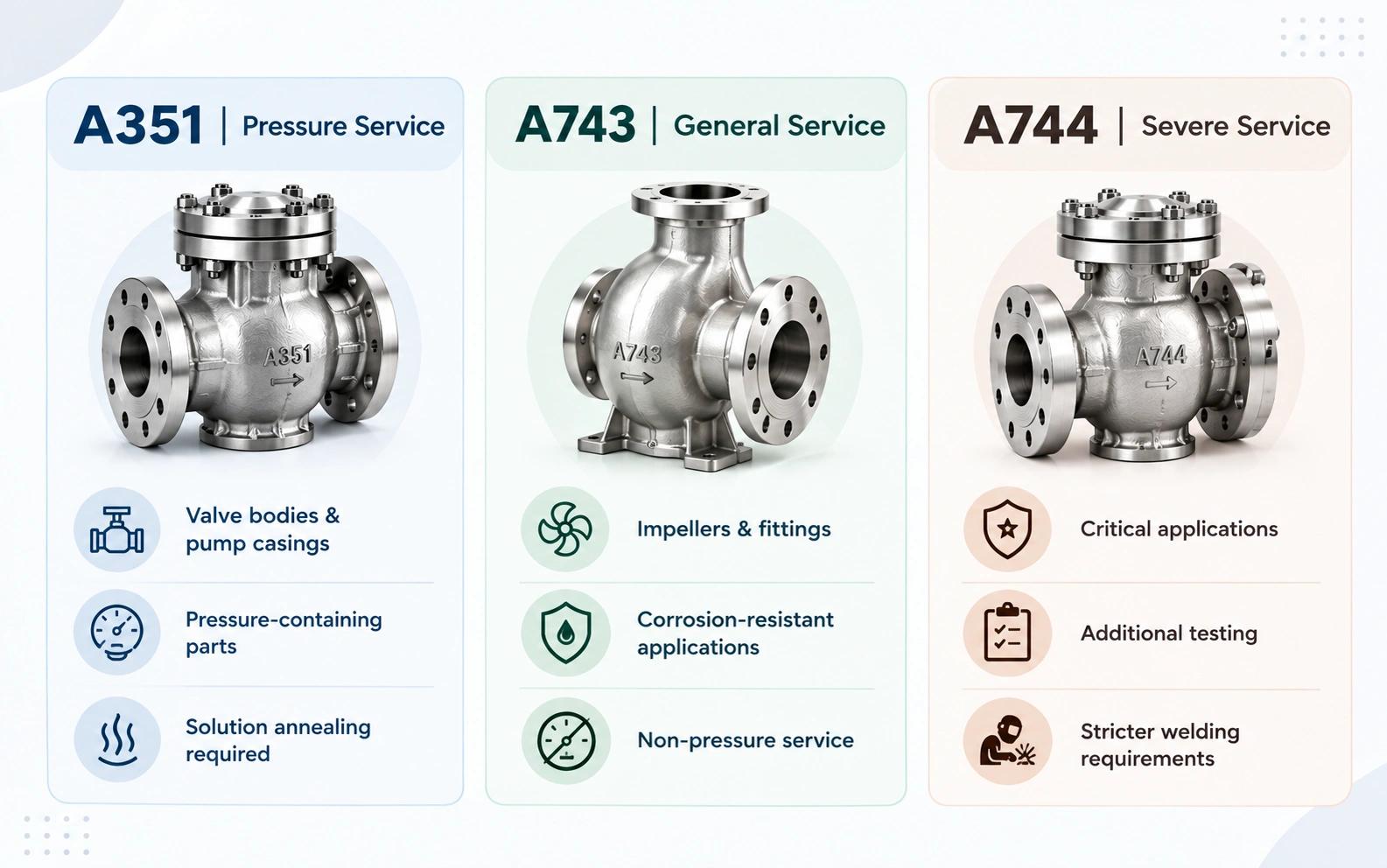
Three ASTM specifications cover CF8M, and the grade is chemically the same in all three. The differences are in what else the specification requires.
ASTM A351 is for pressure-containing parts: valve bodies, pump casings, flanges, fittings. It mandates solution annealing, tensile testing per heat, and it is the specification referenced in ASME B16.34 for valves and in ASME Boiler and Pressure Vessel Code material lists. If the part holds pressure, specify A351.
ASTM A743 is for general corrosion-resistant applications where pressure containment is not the design case: impellers, brackets, wear parts, marine fittings. Heat treatment is still required, but the testing regime is lighter and the price is usually a little lower.
ASTM A744 is for severe service, with additional testing and repair-welding restrictions.
For European buyers, the equivalent route is EN 10213 for pressure purposes and EN 10283 for general corrosion-resistant castings, both using grade 1.4408. Under the Pressure Equipment Directive, a material to a harmonized EN standard is the simplest path to compliance, so if the casting goes into PED-scope equipment, ask whether the foundry can certify to 1.4408 as well as CF8M. The compositions overlap almost entirely (1.4408 allows chromium 18 to 20 and molybdenum 2.0 to 2.5), so a single heat can often be certified to both when the chemistry is controlled to the tighter window.
CF8M equivalents
System | Designation | |
ACI / ASTM | CF8M | |
UNS | J92900 | |
EN / DIN | 1.4408, GX5CrNiMo19-11-2 (older DIN: G-X6CrNiMo 18 10) | |
JIS | SCS14 | |
Wrought equivalent | AISI 316, UNS S31600, EN 1.4401 |
“Equivalent” means nearest match, not identical. When a drawing lists more than one, the foundry certifies whichever governs the purchase order, so name the one you need.
CF8M vs CF8 vs CF3M: how to choose
Choose CF8 (cast 304) when the environment is fresh water, food, dairy, or mild chemicals with no chlorides. It is the lowest-cost of the three because it has no molybdenum.
Choose CF8M when chlorides, seawater, brackish water, or acidic process fluids are present. The 2 to 3% molybdenum gives markedly better pitting and crevice corrosion resistance. This is the default grade for pump and valve castings in water treatment, chemical processing, and offshore service.
Choose CF3M when the part will be welded in the field without a post-weld anneal, or when service temperature stays above about 425°C for long periods. The 0.03% carbon limit avoids carbide precipitation at the weld heat-affected zone. Corrosion resistance is otherwise the same as CF8M, and under A351 the minimum tensile and yield values are identical, although CF3M typically tests a little lower in practice.
If you are choosing between CF8M and CF3M and the part will be supplied fully annealed and not welded afterward, CF8M is the practical choice: same corrosion resistance, a higher temperature ceiling, and more foundries stocking the melt. Precimetal pours all four grades and can advise which fits a specific part during the design-for-manufacturing review.
Where CF8M is used
The majority of CF8M investment castings go into fluid handling. Valve bodies, bonnets, discs, and stems for ball, gate, globe, and check valves. Pump casings and impellers for chemical and seawater duty. Pipe fittings and flanges. Beyond that, the grade shows up in general engineering components such as brackets and housings for coastal installations, in food and pharmaceutical process equipment, and in marine and defence hardware where saltwater exposure rules out 304.
Frequently asked questions
CF8M vs 316: is CF8M the same as 316 stainless steel?
CF8M is the cast version of 316. The two share the same corrosion-resisting principle and molybdenum content, but the cast grade has higher chromium, lower nickel, and contains some ferrite. Specify CF8M for castings and 316 for bar, plate, or forgings.
Is CF8M magnetic?
Slightly. The 5 to 20% ferrite in a cast structure gives a weak magnetic response. Wrought 316 is essentially non-magnetic. A light pull on a magnet is normal and is not a sign of the wrong alloy.
What is the difference between CF8M and CF3M?
Carbon. CF8M allows 0.08% maximum; CF3M allows 0.03%. CF3M is chosen for welded or high-temperature service where carbide precipitation is a risk. Corrosion resistance is otherwise equivalent.
What is the CF8M equivalent in European standards?
EN 1.4408 (GX5CrNiMo19-11-2) under EN 10213 or EN 10283. The composition ranges overlap almost completely, and a foundry can often dual-certify a heat to both.
Does CF8M need heat treatment?
Yes. ASTM A351 and A743 both require solution annealing at 1040°C minimum followed by rapid cooling. Without it the casting is susceptible to intergranular corrosion.
Can CF8M be investment cast?
Yes. CF8M is one of the most common grades in stainless steel investment casting. The lost-wax process suits its geometry-heavy applications such as valve bodies with internal flow paths and impellers with curved vanes.
Conclusion
CF8M is the working stainless of the pump and valve industry for a reason. It combines the corrosion resistance of 316, the castability that a controlled ferrite balance gives, and a standards framework (A351, A743, EN 1.4408) that buyers on both sides of the Atlantic recognize. The decisions that matter are the ones on the drawing: cast grade rather than wrought, the right ASTM or EN specification for the service, and a note on heat treatment verification if corrosion is critical.
Get a quote for CF8M castings
Precimetal Cast has poured CF8M and its related grades in Kadi, Gujarat, since 2001, with in-house solution annealing, CMM inspection, and CNC machining. If you have a CF8M or 1.4408 part to source, send us the drawing and the governing specification. You will get a first response within 24 hours with material confirmation, tooling and per-piece pricing, and lead time. Drawings are held in confidence and we sign NDAs on request.
Share This Article
Need Precision Castings?
We specialize in close-tolerance investment casting for automotive, aerospace, and general engineering applications.
GET A FREE QUOTE
