

Investment Casting Tolerances: CT Grades & Design Guide
Quick answer: Steel investment castings made with silica-sol shells typically hold ISO 8062 grades CT4 to CT6, while water-glass shells usually fall in CT5 to CT9. In practice, that means roughly ±0.3 to ±0.4 mm on a 75 mm dimension at CT6. Surface finish is usually around Ra 1.6–3.2 µm, and walls can go down to about 0.75 mm on very small parts and 1.5–2.5 mm on larger ones. Anything tighter is normally machined.
Casting cost problems often start on the drawing, not on the foundry floor. A title block that says "general tolerance ±0.1 mm" on a 200 mm steel casting pushes every dimension into machining and sharply raises the price. This guide explains how investment casting tolerances are specified, what the CT grade numbers actually mean in millimetres, and how to design a part so the as-cast dimensions do most of the work. If you are new to the method, start with what investment casting is.
What is a CT grade in ISO 8062?
A CT grade (casting tolerance grade) is a class in ISO 8062 that sets the total allowed variation for a cast dimension. The lower the number, the tighter the tolerance. The band widens as the nominal size grows, because longer features shrink and distort more as the metal cools.
The current edition, ISO 8062-3, renames these as DCTG (dimensional casting tolerance grades) and adds two more systems that drawings often miss: GCTG for geometric tolerances such as flatness and straightness, and RMAG for required machining allowance. The numeric bands for linear dimensions follow the older CT table, so most foundries still say "CT6" in conversation.
ISO 8062 CT grades: values for typical sizes
The values below are total tolerance in millimetres from the ISO 8062 table. Unless the drawing says otherwise, the band is split evenly, so CT6 at 63–100 mm means ±0.39 mm.
Nominal size (mm) | CT4 | CT5 | CT6 | CT7 | CT8 | CT9 | |
25 – 40 | 0.32 | 0.46 | 0.64 | 0.90 | 1.3 | 1.8 | |
40 – 63 | 0.36 | 0.50 | 0.70 | 1.0 | 1.4 | 2.0 | |
63 – 100 | 0.40 | 0.56 | 0.78 | 1.1 | 1.6 | 2.2 | |
100 – 160 | 0.44 | 0.62 | 0.88 | 1.2 | 1.8 | 2.5 | |
160 – 250 | 0.50 | 0.70 | 1.0 | 1.4 | 2.0 | 2.8 | |
250 – 400 | 0.56 | 0.78 | 1.1 | 1.6 | 2.2 | 3.2 |
Which grade a foundry can hold depends mainly on the shell system. Silica-sol shells, used for precision metal casting of stainless and alloy steel, are generally placed at CT4–CT6. Water-glass shells, common for lower-cost carbon steel parts, sit at roughly CT5–CT9. Precimetal Cast uses [silica sol / confirm] shells, which is why our standard offer is [CT5–CT6 / confirm] on most features.
CT grades vs VDG P690: an easy-to-miss mismatch
Many European and Indian buyers specify VDG P690 instead of ISO 8062. Precimetal works to VDG P690 and IS 11166, so we compared the two directly using the published VDG P690 values on our capabilities page:
Dimension | CT5 | CT6 | CT7 | VDG D3 | VDG D2 | VDG D1 | |
35 mm | ±0.23 | ±0.32 | ±0.45 | ±0.25 | ±0.31 | ±0.40 | |
75 mm | ±0.28 | ±0.39 | ±0.55 | ±0.30 | ±0.37 | ±0.45 | |
200 mm | ±0.35 | ±0.50 | ±0.70 | ±0.75 | ±0.95 | ±1.20 |
On small features, VDG D2 lines up closely with CT6, and D3 with CT5. Above about 180 mm the picture changes: even VDG D3 is looser than CT7. So a drawing that calls out CT6 on a 200 mm length is asking for roughly ±0.50 mm, which is tighter than the best VDG class. Check which standard your drawing cites before you compare quotes from different foundries, or you may be comparing two different tolerance levels.
Investment casting design guidelines that protect tolerance
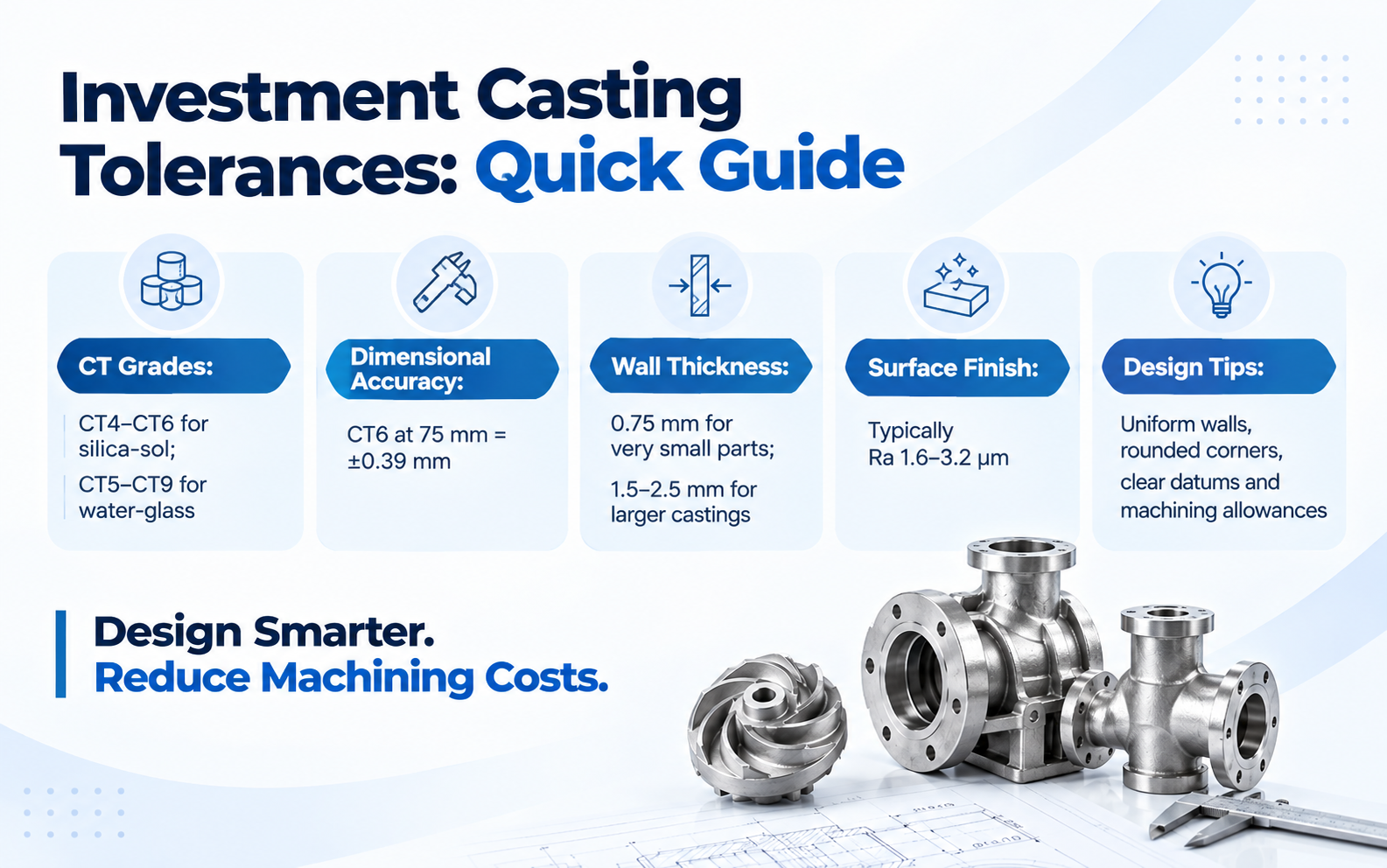
Tolerance is not only a foundry setting. Part geometry decides how much the wax, shell and metal move. These investment casting design guidelines make the biggest difference:
- Keep walls uniform. Heavy sections next to thin ones cool at different rates, which pulls flat faces out of shape and causes shrinkage.
- Add fillets at every internal corner. Sharp corners concentrate stress and trap shrinkage; a radius also helps the shell coat evenly.
- Tolerance only what matters. Put tight limits on mating and functional features and use the general CT grade everywhere else.
- Define datums the foundry can use. Datums on as-cast surfaces let the foundry check and correct the die; datums on machined faces only work after machining.
- Call out flatness and straightness separately. Long thin parts warp; specify a GCTG or a geometric tolerance instead of relying on linear limits.
- State machining allowance. Show which faces are machined and how much stock you need, or use an RMAG grade.
Minimum wall thickness for investment casting
Published design guides from investment casting foundries put the practical minimum at about 0.75 mm for very small castings and 1.5–2.5 mm for medium and larger parts. The real limit depends on how far the metal must flow and on the alloy: stainless and duplex grades need more section than carbon steel to fill thin areas. At Precimetal, we suggest designing [X mm / confirm] as the minimum wall on parts up to 30 kg, and we review thinner walls case by case with a sample casting before tooling is finalised.
Thin walls also affect tolerance. A 1.5 mm rib may fill perfectly but still bow, so pair any minimum-wall feature with a flatness or straightness callout.
Investment casting surface finish
As-cast investment casting surface finish at Precimetal is Ra 1.6–3.2 µm (roughly 63–125 µin), compared with much rougher sand-cast surfaces. Finish depends on the primary shell coat, the alloy and the cleaning method. Shot blasting gives an even matte surface but can slightly change the Ra, so specify finish after cleaning, not just "as cast". Where a seal face or bearing seat needs Ra 0.8 µm or better, plan to machine it; our CNC turning and 4-axis VMC hold machined features within 50 microns.
How tight tolerances change cost
Every step tighter than the process naturally holds adds work: die corrections after first-article inspection, straightening, coining or machining. A practical way to think about it:
- General CT grade: no extra cost, held by the wax die and process control.
- One grade tighter on a few features: usually achievable with die correction and 100% CMM checks on first articles.
- Below CT4 or under ±0.1 mm: plan to machine those features.
Examples of how this works on real parts are in our guides to pump casing casting and CF8M material. Industry-specific capabilities are listed on our automotive castings and pump and valve castings pages.
Conclusion
Achieving the right investment casting tolerances requires balancing dimensional accuracy, component performance and manufacturing costs. Apply tighter tolerances only to critical features, maintain uniform wall thickness, specify machining allowances and define geometric requirements clearly. Confirm the applicable ISO 8062, VDG P690 or IS 11166 standard before finalising your engineering drawing. At Precimetal Cast, share your 2D drawing and 3D model for an engineering review to identify as-cast dimensions, machining requirements and practical tolerance limits before tooling begins.
FAQ
What tolerance can investment casting achieve?
Steel investment castings typically hold ISO 8062 CT4 to CT6 with silica-sol shells, about ±0.3 to ±0.4 mm on a 75 mm dimension at CT6. Tighter features are machined.
What does CT6 mean in casting?
CT6 is an ISO 8062 casting tolerance grade. It allows a total variation of 0.78 mm on a 63–100 mm dimension, or ±0.39 mm when split evenly.
What is the minimum wall thickness for investment casting?
About 0.75 mm is possible on very small parts, but 1.5–2.5 mm is the practical range for medium and larger castings, depending on alloy and flow length.
What is the surface finish of investment casting?
Typically Ra 1.6–3.2 µm as cast. Surfaces that need Ra 0.8 µm or finer are usually machined or polished.
Is VDG P690 the same as ISO 8062?
No. They are separate standards. On small dimensions VDG D2 is close to CT6, but above about 180 mm VDG classes are looser than CT7.
Is investment casting more accurate than sand casting?
Yes. Green sand casting usually falls around CT11 to CT14, several grades looser than investment casting, and leaves a rougher surface.
Comparing suppliers? Read how to choose an investment casting manufacturer, or see our full investment casting process.
Share This Article
Need Precision Castings?
We specialize in close-tolerance investment casting for automotive, aerospace, and general engineering applications.
GET A FREE QUOTE
