

Investment Casting Cost: Price per Part, Tooling & Lead Time
Quick answer Investment casting cost has two parts: a one-time tooling charge (mainly the wax injection die) and a piece price. The piece price depends on the alloy and poured weight, part complexity and cores, tolerances and machining, testing and certificates, order volume and expected scrap. Because tooling is paid once, its share of each part's cost falls as volume grows. For an accurate quote, send a 3D model, a toleranced 2D drawing, the material grade, annual quantity and the tests you need.
Collect three quotes for the same casting and they are often far apart. Usually the suppliers did not price the same scope: one included machining and radiography, another quoted only the raw casting. This guide explains how an investment casting price is built, what drives each part of it, and how to get quotes you can actually compare.
How an investment casting quote is built
Every quote splits into one-time costs and recurring piece costs.
Cost element | What it covers | |
Tooling (one-time) | The wax injection die that forms each wax pattern, plus core dies and fixtures where needed. Every casting starts from this die. | |
Samples / first article | Sample castings, dimensional report, material test results and customer approval documents such as PPAP. | |
Metal | The poured weight: the part plus gates, runners and feeders. Poured weight is always higher than finished weight. | |
Wax and ceramic shell | Pattern wax, ceramic slurry and stucco, and the labour to build the shell coat by coat. | |
Heat treatment and finishing | Solution annealing for stainless grades, shot blasting, gate grinding, and pickling or passivation. | |
Machining | Any face, bore or thread tighter than as-cast tolerance. | |
Inspection and documents | Dimensional checks, NDT, PMI, pressure testing and EN 10204 material certificates. | |
Packing and freight | Export packing and the agreed Incoterm (ex-works, FOB or delivered). |
Some suppliers quote a price per kg. It is a handy shorthand for simple parts, but it hides what really separates two parts of the same weight: cores, tolerances, machining and testing. Always ask for a price per piece with the scope written out.
7 factors that drive investment casting price
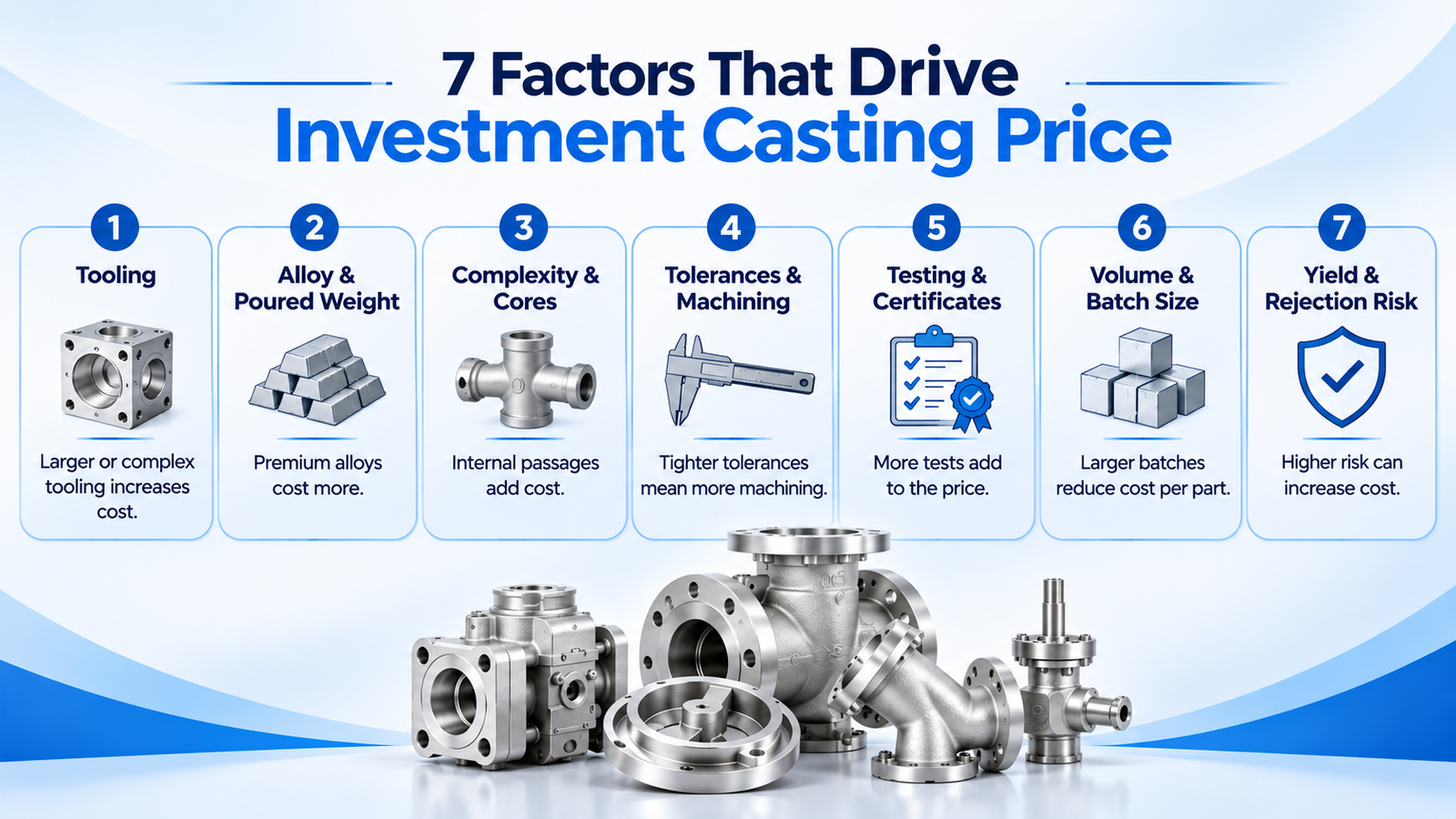
Industry sources consistently list tooling, part size and shape, alloy, quality and dimensional requirements, and quantity as the main cost drivers. Here is what each one means in practice.
1. Tooling
The wax die is usually machined from aluminium. Its cost rises with part size, the number of slides needed to release undercuts, and the number of cavities. A multi-cavity die costs more up front but lowers the piece price on high-volume parts. Before approving tooling, confirm who owns the die, how many shots it should last, and who pays for modifications if the drawing changes.
2. Alloy and poured weight
Alloy price follows the alloying elements. Molybdenum-bearing CF8M costs more per kg than CF8, and duplex and nickel alloys cost more again. Specify the grade the service conditions actually need; our CF8 vs CF8M vs CF3 vs CF3M guide explains when the upgrade is justified.
3. Complexity and cores
Internal passages need soluble or ceramic cores, each with its own die and extra handling. Machine Design notes that cores made this way can double the piece price. If a passage can be opened up or drilled after casting, ask for both options to be priced.
4. Tolerances and machining
Every dimension tighter than the as-cast tolerance class needs machining or extra correction. A drawing that applies machined tolerances to every dimension is the most common cause of an inflated quote. Keep the tight tolerances for functional features such as sealing faces, bores and mating surfaces. See our guide to investment casting tolerances.
5. Testing and certificates
Radiography, dye penetrant, PMI and pressure testing add cost, and on pressure-retaining parts they are often essential. Specify them in the RFQ so they are priced from the start. An EN 10204 3.2 certificate needs an independent inspector, so it costs more and takes longer than a 3.1.
6. Volume and batch size
Each production run carries set-up work, and larger batches spread it more thinly. Investment casting is generally most economical for batches of about 100 to 5,000 parts. Share your annual volume and call-off plan, not just the first order quantity.
7. Yield and rejection risk
Foundries price in their expected scrap. Sudden changes in wall thickness, sharp internal corners, and isolated heavy sections raise the risk of shrinkage porosity. A design that casts reliably gets a lower quote.
How tooling cost affects price per part
Investment casting lead time
Lead time comes in three stages, and quotes should state each one separately:
- Tooling: die design, machining and wax trials.
- Samples and approval: sample castings, dimensional report, material certificates and customer sign-off.
- Repeat production: wax, shell, pour, heat treatment, finishing, machining and inspection.
Shell building cannot be rushed, because each ceramic coat must dry before the next is applied. Most avoidable delays come from drawing revisions after tooling has started, or tests added after the order is placed.
Hidden costs to check when comparing quotes
- Machining quoted separately, or not quoted at all.
- NDT or 3.2 certification added after the price is agreed.
- Tool modifications after sampling.
- Ex-works prices compared with delivered prices.
- Low quotes from suppliers with poor yield, which come back as delays and replacement parts.
For a wider supplier checklist, read how to choose an investment casting manufacturer.
What to send for an accurate quote
- 3D model (STEP/IGES) and a 2D drawing with tolerances, datums and surface finish.
- Material grade and standard (for example ASTM A351 CF8M or EN 1.4408) and heat-treatment condition.
- Annual quantity, first-order quantity and call-off pattern.
- Features that must be machined, or the finished-part drawing.
- Testing and certificates: NDT method and acceptance level, PMI, pressure test, EN 10204 3.1 or 3.2.
- Surface treatment, marking, packing and delivery terms.
- Target price, if you have one, so the foundry can suggest design changes to meet it.
How to reduce investment casting cost
- Relax non-functional tolerances to the as-cast grade.
- Keep walls uniform and add generous fillet radii to improve yield.
- Avoid cores where a passage can be opened up or drilled.
- Consolidate parts: one casting can replace a welded or bolted assembly.
- Involve the foundry before the drawing is released. Changes cost almost nothing at that stage.
Investment casting cost vs other processes
Investment casting is rarely the cheapest process per kilogram of metal, but it is often the cheapest way to get a finished part. The comparison depends on the part:
Process | When it costs less than investment casting | |
Sand casting | Large, heavy parts with loose tolerances, where a rougher surface and extra machining stock are acceptable. | |
Pressure die casting | Very high volumes of aluminium or zinc parts. It is not used for steel, and the dies cost far more. | |
CNC machining from bar | Prototypes, very low volumes and simple shapes, where no tooling is needed. | |
Fabrication | Simple shapes built from standard plate or tube in small quantities. |
Investment casting wins on complex steel and stainless parts in low-to-medium volumes. Thin walls, undercuts, internal passages and fine detail come out close to final shape, so machining, assembly and welding costs drop. If your part is currently machined from solid or welded from several pieces, compare the total finished-part cost, not just the casting price.
FAQ
How much does investment casting tooling cost?
It depends on part size, the number of slides and cores, and the number of cavities. Simple single-cavity dies cost far less than dies with cores and multiple slides. A drawing is needed for a firm figure.
Is investment casting expensive?
The piece price is usually higher than for sand casting. But because the part comes out close to final shape, it needs far less machining, so complex parts in medium volumes often cost less overall.
What is the minimum order quantity for investment casting?
Tooling makes one-off parts uneconomical. From a few hundred parts a year, the tooling cost per part becomes small.
Why do investment casting quotes vary so much?
Suppliers often quote different scope. Send the same complete RFQ to each supplier and compare the effective cost per part.
How long does investment casting take?
There are three stages: tooling, samples and approval, then repeat production. Ask each supplier to quote all three separately.
Get an itemised quote from Precimetal Cast
Precimetal Cast has made precision investment castings in stainless steel, carbon steel and alloy steel since 2001. Tooling, heat treatment, CNC machining and inspection are all done in-house, and we are certified to ISO 9001:2015 and IATF 16949:2016. Send your drawing and we will quote tooling, piece price, machining and testing as separate lines, so you know exactly what you are paying for. See our casting process or contact us.
Share This Article
Need Precision Castings?
We specialize in close-tolerance investment casting for automotive, aerospace, and general engineering applications.
GET A FREE QUOTE
