

Valve Investment Castings: Which Valve Parts Can Be Cast, Materials and Testing
Investment casting suits small to medium valve parts with complex shapes: bodies (typically up to about DN100 / 4 inch), bonnets, gate wedges, globe and check discs, butterfly discs, control valve cages and plugs, yokes and gland flanges. Stems, springs and fasteners are usually made from bar or forgings. The most common grades are CF8M and CF3M stainless, WCB carbon steel and duplex. For pressure-retaining parts, specify a 3.1 material certificate, NDT and a pressure test.
Valve makers move parts to investment casting for one main reason. The casting comes out close to the finished shape, so there is less machine and fewer places for a leak to start. Not every valve part should be cast, though, and the grade and test plan matter as much as the process. This is how we look at a valve drawing when it arrives, and what we suggest buyers specify for pump and valve castings.
Why use investment casting for valve parts?
- Near-net shape. Flow passages, bosses and markings come straight out of the mould. Machining is limited to seats, bores, threads and end connections.
- Tight tolerances and a clean surface. Silica-sol shells typically hold ISO 8062 CT4 to CT6, with roughness around Ra 1.6–3.2 µm. That means smoother flow paths and less finishing.
- Almost any alloy. Stainless, carbon, alloy and duplex steels all go through the same lost-wax process.
- Repeatability. One wax die produces thousands of identical parts, batch after batch.
Which valve parts can be investment cast?
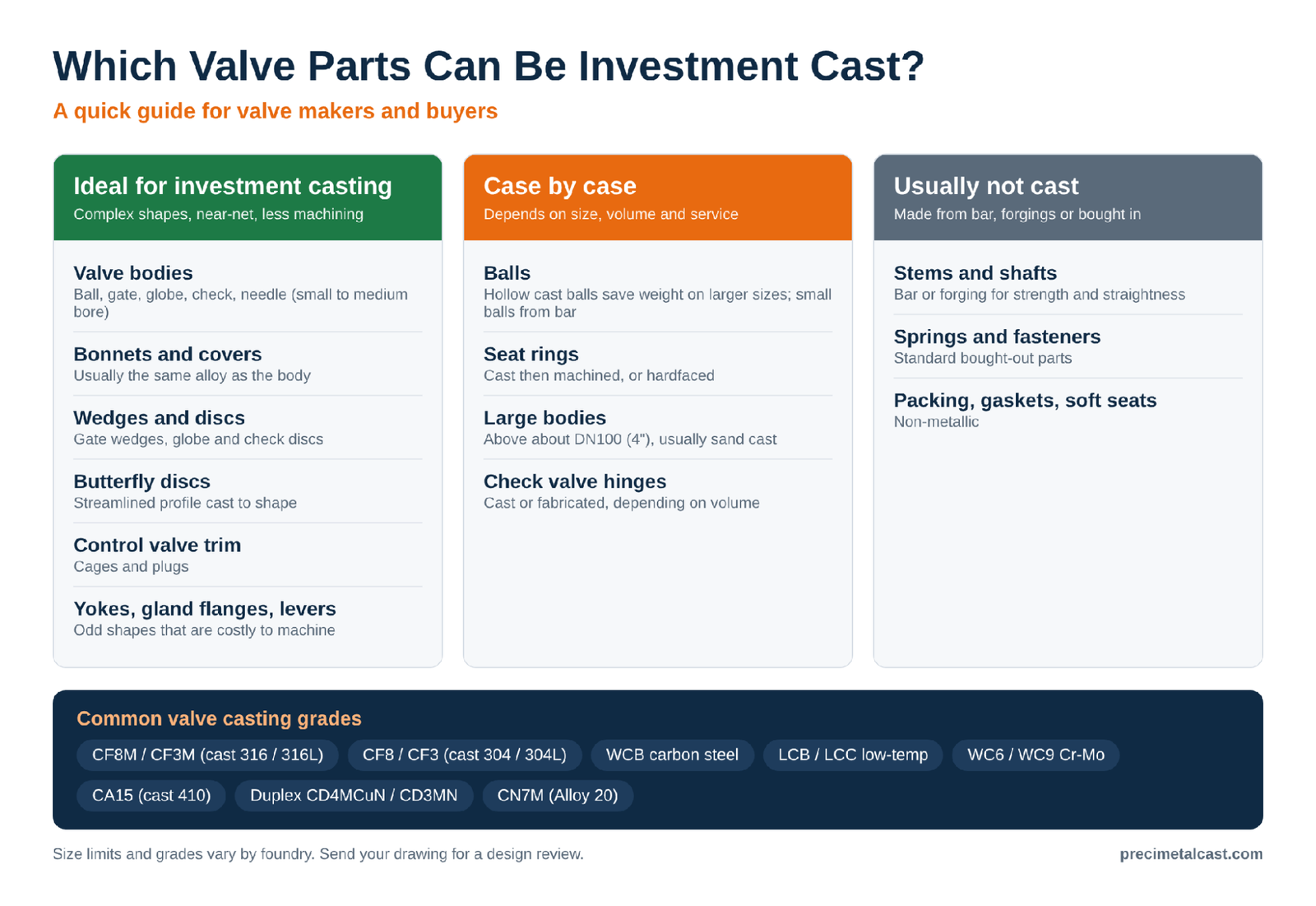
Part | Valve types | Cast? | Notes | |
Body | Ball, gate, globe, check, needle | Yes, ideal | Internal passages cast in. Seats and ends machined | |
Bonnet / cover | Gate, globe, check | Yes | Usually the same grade as the body | |
Wedge / disc | Gate, globe, check | Yes | Seating faces machined or hardfaced | |
Butterfly disc | Butterfly | Yes | Streamlined profile cast to shape | |
Cage / plug | Control | Yes | Often martensitic or PH stainless for wear | |
Yoke, gland flange, lever | Most types | Yes | Awkward shapes that are costly to machine | |
Ball | Ball | Case by case | Hollow cast balls save weight on larger sizes | |
Seat ring | Many | Case by case | Often from bar, or hardfaced | |
Stem / shaft | All | Usually not | Bar or forging for strength and straightness |
Pumps follow the same logic: complex, pressure-retaining shapes are cast and shafts are not. See our pump casing casting guide for volutes and impellers.
Have a valve drawing? Send it for a free design review and quote. We reply within 48 hours.
What materials are used for valve castings?
Start from the service conditions: fluid, pressure, temperature and any chlorides or H₂S. Then pick the lowest-cost grade that handles them.
Grade (standard) | Wrought equivalent | Typical valve service | |
CF8 / CF8M (ASTM A351) | 304 / 316 | Water, chemicals, food and general corrosive service | |
CF3 / CF3M (ASTM A351) | 304L / 316L | Welded parts, better resistance to intergranular corrosion | |
WCB (ASTM A216) | Carbon steel | Oil, gas, steam and water in non-corrosive service, about −29 to 425 °C | |
LCB / LCC (ASTM A352) | Low-temperature carbon steel | Low-temperature service down to −46 °C | |
WC6 / WC9 (ASTM A217) | Cr-Mo steel | High-temperature steam and power plant | |
CA15 (ASTM A217 / A743) | 410 | Trim, seats and steam service | |
CD4MCuN / CD3MN (ASTM A890 / A995) | Duplex | Seawater, chlorides, desalination | |
CN7M (ASTM A351 / A744) | Alloy 20 | Sulphuric acid service |
For most stainless valve bodies the choice is between CF8M and its low-carbon and molybdenum-free relatives. Our CF8 vs CF8M vs CF3 vs CF3M comparison covers the differences, and this post explains when cast 316 beats bar. For sour service, hardness limits apply. See our NACE MR0175 materials guide.
Which tests should valve castings pass?
Pressure-retaining parts need more than a visual check. Agree the test plan before tooling, so the gating and sample inspection are built around it.
Test | What it checks | When to specify | |
Chemical analysis + EN 10204 3.1 certificate | Correct grade | Always | |
Tensile and hardness | Mechanical properties | Pressure parts. Hardness limits for sour service | |
Visual to MSS SP-55 | Surface irregularities | Bodies, bonnets and other valve castings | |
Dye penetrant (PT) / magnetic particle (MT) | Surface cracks | Critical areas and weld repairs. MT only on magnetic grades | |
Radiography (RT) | Internal shrinkage and porosity | Pressure-retaining bodies, per ASME B16.34 or your spec | |
Intergranular corrosion (ASTM A262) | Sensitisation | Austenitic stainless in corrosive service | |
PMI | Alloy mix-ups | Critical service, mixed-alloy assemblies | |
Shell / hydrostatic test | Leak-tightness | Usually on the assembled valve (API 598 / ISO 5208). Machined bodies at the foundry if asked | |
Dimensional / CMM report | Fit to drawing | First articles and periodic checks |
European buyers often add a surface standard such as VDG P690 to the purchase order to avoid disputes about finish.
How do you avoid leaks in cast valve bodies?
Most leaks in cast valves trace back to shrinkage where a heavy section meets a thin wall. Five design habits prevent most of them:
- Keep wall thickness as even as possible, with gradual transitions into flanges and bosses.
- Use generous internal fillets. Sharp inside corners trap shrinkage.
- Keep gates and risers away from seats and sealing faces.
- Mark critical areas (seat, bonnet joint, end connections) on the drawing so RT and PT focus there.
- Leave machining allowance on every sealing face. Never seal on an as-cast surface.
A good foundry raises these points in its design review before quoting. If yours doesn't, read how to choose an investment casting manufacturer.
Valve castings from Precimetal Cast
Precimetal Cast Pvt Ltd makes investment-cast valve bodies, bonnets, discs and trim at Kadi GIDC, Gujarat. We cast and machine in-house, inspect on CMM, and supply full material and test documentation under an IATF 16949 certified system. See our casting process, certifications and full pump and valve casting range.
Need valve castings made for your drawing?
Send your drawing, grade and annual quantity for a free design review and a quote within 48 hours.
Request a quote | WhatsApp: +91 76000 28290 | Download the brochure
Frequently asked questions
Which valve parts are made by investment casting?
Bodies, bonnets, gate wedges, globe and check discs, butterfly discs, control valve cages and plugs, yokes, gland flanges and levers. Stems and fasteners are usually made from bar or forgings.
What size valve bodies can be investment cast?
Usually small to medium bores, up to about DN100 (4 inch). Larger bodies are normally sand cast. The exact limit depends on the foundry's maximum pour weight.
What is the best material for valve castings?
It depends on the service. CF8M suits general corrosive service, WCB suits non-corrosive oil, gas, steam and water, LCB or LCC suits low temperatures, and duplex suits seawater and chlorides.
What does CF8M mean on a valve?
It means the valve body is cast to ASTM A351 grade CF8M, the cast equivalent of 316 stainless steel, with about 19% chromium, 10% nickel and 2–3% molybdenum.
Is investment casting better than forging for valves?
For complex small and medium bodies, usually yes: there is less machining and a better flow-path finish. Forging suits small, very high-pressure valves with simple outer shapes.
Which tests are required for valve castings?
At minimum, chemical and mechanical tests with a 3.1 certificate and a visual check to MSS SP-55. Pressure-retaining parts usually add PT or MT, radiography and a hydrostatic shell test.
Share This Article
Need Precision Castings?
We specialize in close-tolerance investment casting for automotive, aerospace, and general engineering applications.
GET A FREE QUOTE
